NFL Betting Odds UK: Line Comparisons and Margin Conversions
 Available in US
Table of Contents
- Odds Format Conversions: American, Fractional and Decimal Math
- Step-by-Step: Converting American Odds to Fractional and Decimal
- Extracting Implied Probability and Spotting Overround
- Why NFL Lines Move: Injury Reports, Weather and Sharp Action
- Comparing NFL Odds Across UK Bookmakers: Where the Margin Hides
- NFL Odds UK: Your Questions Answered
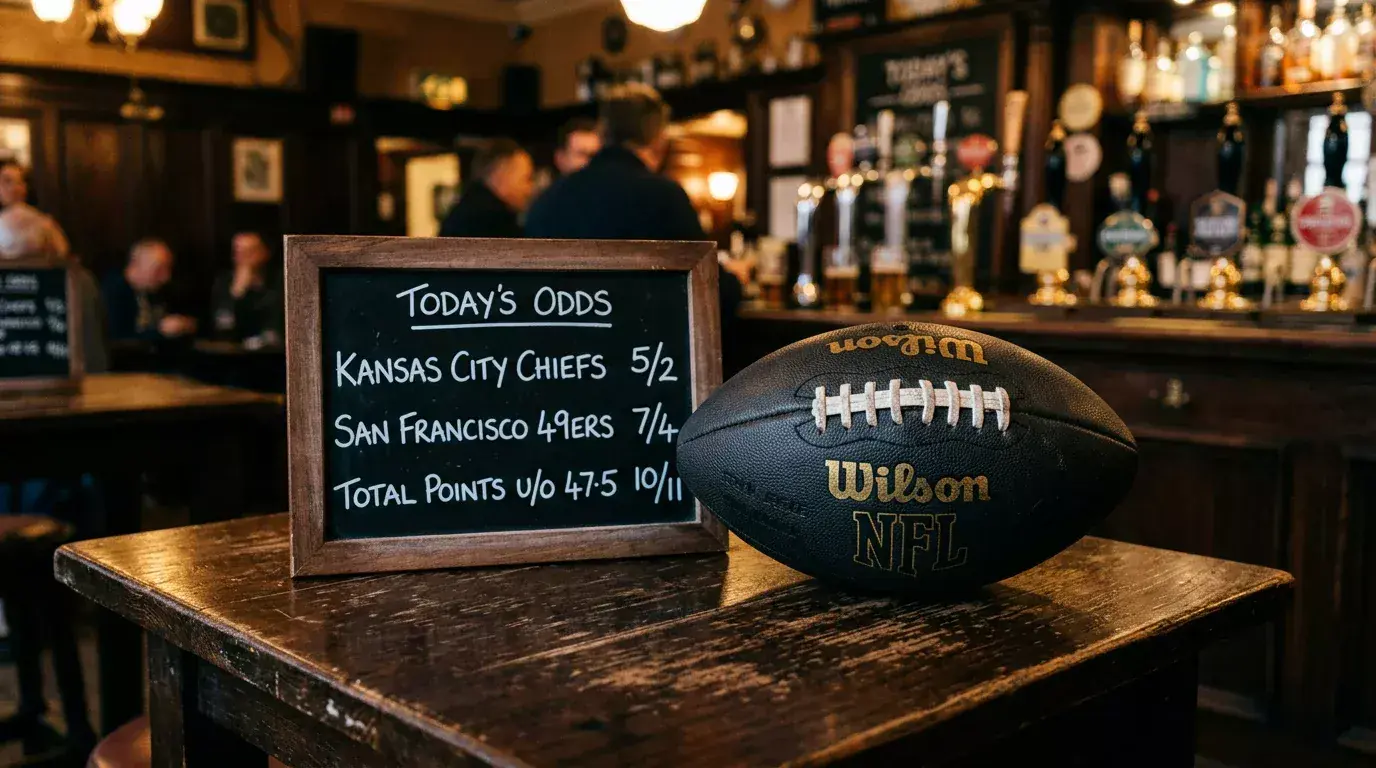
The first time I tried to bet on an NFL game from London, the odds on the US broadcast read “-145” and I had no idea whether that was good value or a trap. My UK bookmaker was showing the same game at 4/6. Were those the same price? Better? Worse? I stared at my screen for ten minutes, placed the bet anyway, and spent the next three hours annoyed at myself for not understanding what I had bought. That confusion cost me about 12 pounds in overpaid margin before I figured out the maths — not a fortune, but enough to teach me that odds literacy is not optional if you are serious about NFL wagering in the UK.
With 290 million online bets placed monthly across the UK market, the sheer volume of money moving through bookmaker platforms is staggering. A meaningful and growing share of that action lands on American football, and the punters who do not understand the relationship between American lines, fractional odds, and decimal prices are giving away value on every single wager. This guide breaks down the three formats you will encounter, shows you how to convert between them in your head or on paper, explains how to extract the implied probability hidden inside any price, and walks through the mechanics of line movement so you can stop guessing and start reading the market like a professional.
Odds Format Conversions: American, Fractional and Decimal Math
Three formats, one reality. Every set of odds — whether displayed as -150, 2/3, or 1.67 — is expressing the same underlying concept: how much you need to stake to win a given amount, and by extension, what probability the bookmaker assigns to that outcome. The format is just the language. The price is the price.
American odds are the native format of US sportsbooks, and since NFL lines originate in the American market, you will encounter them constantly if you follow line movement, listen to US podcasts, or read analysis from across the Atlantic. They come in two flavours. A negative number, like -200, tells you how much you need to stake to win 100 units of profit. So -200 means you put up 200 to win 100 — a total return of 300 on a successful bet. A positive number, like +180, tells you how much profit you earn on a 100-unit stake. +180 means you risk 100 and collect 180 in profit if you win — total return 280. The dividing line at -100/+100 represents an even-money proposition before the bookmaker’s margin.
Fractional odds are the traditional UK format — the one you grew up with if you ever had a flutter on the Grand National. They express profit relative to stake. Odds of 5/1 mean five pounds of profit for every one pound staked. Odds of 1/2 mean one pound of profit for every two pounds staked. The fraction tells you the ratio directly: numerator is profit, denominator is stake. For NFL markets, UK bookmakers typically display fractional odds alongside decimal as a default, though most now let you toggle between formats in your account settings.
Decimal odds, dominant in continental Europe and increasingly popular in the UK, express total return per unit staked. Decimal 3.00 means three pounds back for every one pound wagered — that is two pounds of profit plus your original one-pound stake. Decimal 1.50 means 1.50 back per pound, or 50 pence profit. The beauty of decimal is its simplicity: multiply your stake by the decimal price and you have your total return, no mental gymnastics required. For comparing prices across multiple bookmakers, decimal is the fastest format because larger numbers always mean better prices, with no sign conventions or fraction reductions to interpret.
The remote betting sector in the UK generates roughly 2.6 billion pounds in gross gambling yield annually, and the operators processing that money display odds in all three formats depending on the punter’s preference and the market’s origin. If you bet on NFL from the UK, you will see American odds on analysis sites, fractional odds on legacy platforms, and decimal odds on modern interfaces. Being fluent in all three is not academic — it is the difference between spotting a mispriced line instantly and missing it because the format confused you.
A quick reference for the three most common NFL price points. The standard spread price in American format is -110 on each side, which translates to 10/11 fractional and 1.91 decimal. A moderate favourite on the moneyline at -200 American is 1/2 fractional and 1.50 decimal. A moderate underdog at +200 American is 2/1 fractional and 3.00 decimal. Memorise those three benchmarks and every other price becomes a variation you can estimate relative to them.
Step-by-Step: Converting American Odds to Fractional and Decimal
I carry two formulas in my head and reach for them every single week during the NFL season. They take about thirty seconds to apply and they have saved me from mispricing my own bets more times than I can count. Here they are, broken down so you can use them immediately.
Converting American to decimal depends on whether the number is positive or negative. For a positive American line, say +250: divide the number by 100 and add 1. So +250 becomes 250/100 + 1 = 3.50 decimal. For a negative American line, say -150: divide 100 by the absolute value and add 1. So -150 becomes 100/150 + 1 = 1.667 decimal. That is it. Two operations, and you have the price in the format most useful for comparison.
Converting American to fractional follows the same logic but stops one step earlier. For a positive line, +250: divide by 100 to get 250/100, which simplifies to 5/2. Your profit is five units for every two staked. For a negative line, -150: flip it, so 100/150, which simplifies to 2/3. Your profit is two units for every three staked. If the fraction does not reduce neatly, most UK bookmakers will display the unsimplified version, so do not worry about elegance — the maths is what matters.
Let me walk through a real-world example. You are watching a US broadcast and the line for the Kansas City Chiefs at home is -175 on the moneyline. You want to compare this against your UK bookmaker’s fractional price. Step one: 100/175 = 0.571. Step two: that is the fractional decimal form of 4/7 (because 4 divided by 7 is 0.571). Your UK book is showing 4/7. Same price — no edge, no loss. But if your UK book is showing 1/2 (0.500 in decimal fraction form), that translates to -200 American, which is a worse price than the -175 you saw on the broadcast. The US price implies a 63.6% probability; the UK price implies 66.7%. That three-percentage-point difference is pure margin in the bookmaker’s favour, and if you are not doing this conversion, you will never know it exists.
For those who prefer not to do mental arithmetic during a Sunday evening session: every major UK bookmaker now offers a toggle in account settings that lets you switch between American, fractional, and decimal displays. Set it to decimal for the season, do your comparisons in that format, and only convert manually when you are reading US-sourced analysis that quotes American odds. The toggle eliminates the busywork; the formula remains in your back pocket for the situations where you need it — and you will need it more often than you expect.
One more conversion worth learning: going from decimal to implied probability. Divide 1 by the decimal price and multiply by 100. Decimal 1.91 becomes 1/1.91 * 100 = 52.4%. Decimal 3.00 becomes 1/3.00 * 100 = 33.3%. This tells you what probability the bookmaker has built into the price, before their margin. It is the single most important number you can extract from any odds format, and it feeds directly into the next concept: overround.
Extracting Implied Probability and Spotting Overround
Every bookmaker builds a cushion into their odds. They do not offer you a fair price — they offer you a price that, if the market were perfectly efficient, guarantees them a profit regardless of the outcome. That cushion is called the overround, and understanding it is the difference between knowing what you are paying and blindly handing over money.
Here is how it works. Take a standard NFL spread market priced at -110 on each side. Convert both to implied probability: 1/1.91 * 100 = 52.36% for each team. Add them together: 52.36% + 52.36% = 104.72%. In a fair market, the two probabilities would sum to exactly 100%, because one team will cover and the other will not. The 4.72% above 100% is the overround — the bookmaker’s theoretical edge. It means that for every 100 pounds wagered across both sides of this spread, the bookmaker expects to retain about 4.72 pounds. That is their margin, and it comes directly out of the punter’s expected returns.
The hold rate across regulated US sportsbooks climbed from 6.7% in 2018 to above 9% by 2025, which means bookmakers are extracting a larger share of every dollar and pound that flows through their platforms. Part of that increase comes from the growth of parlay betting, where the compounding margin is brutal, but part of it reflects tighter pricing on straight bets as well. Jim Strode, an associate professor of sport management at Ohio University, put it plainly when he described the NFL as a business seeking revenue — and the betting market is part of that revenue ecosystem, with bookmakers positioned to capture an ever-larger slice.
For UK punters, the practical step is this: before placing any NFL bet, calculate the overround on the market you are entering. If the spread is -110/-110 (1.91/1.91 decimal), the overround is 4.7%. If the moneyline is -200/+170 (1.50/2.70), the implied probabilities are 66.7% and 37.0%, summing to 103.7% — a 3.7% overround. A totals market priced at -105/-115 (1.95/1.87) sums to 51.3% + 53.5% = 104.8%. Compare these across bookmakers. If one operator’s overround on the same game is 3.5% and another’s is 5.5%, the first is offering you objectively better value on that specific market, regardless of which side you back.
I track overround by bookmaker across the season. Over time, patterns emerge: certain operators consistently offer tighter NFL spreads, others are sharper on totals, and a few price moneylines more aggressively to attract action. Knowing which book is cheapest on which market type saves time when you are line shopping under the pressure of a Sunday evening deadline. It also reveals something the bookmakers would rather you did not notice — that the margin is not uniform. It varies by market, by game profile, and by how much public attention the matchup attracts. High-profile games tend to carry lower overrounds because the volume is sufficient for the bookmaker to profit even at thinner margins. Lower-profile early window games often carry wider margins because the betting public is less price-sensitive when the stakes feel smaller.
Why NFL Lines Move: Injury Reports, Weather and Sharp Action
On a Tuesday morning last October, I watched a spread move from -3 to -1.5 in under four hours. No injury had been announced. No weather report had changed. The shift was driven entirely by money — specifically, sharp money from professional syndicates who believed the line was mispriced and bet enough to force the bookmaker’s hand. By the time casual punters logged on that evening, the number had already settled at -2, and the window of value had closed.
NFL lines move for three primary reasons: injury information, weather forecasts, and betting action. Of these, action is the most consistent driver. Bookmakers set opening lines based on power ratings, historical data, and the official feeds supplied through their data partnerships — Genius Sports holds the exclusive contract to distribute official NFL data through at least Super Bowl 2030, and that pipeline is the backbone of modern line-setting. But once the line is posted, the market takes over. If disproportionate money lands on one side, the bookmaker adjusts the price to manage liability and attract action on the other side. That adjustment is line movement, and reading it correctly is one of the most valuable skills in NFL betting.
Injury reports are the most visible catalyst. The NFL mandates that teams publish practice participation reports on Wednesday, Thursday, and Friday during the regular season, with game-day statuses released on Friday afternoon. A starting quarterback listed as “doubtful” on the Friday report can move a spread by three or more points. What matters for the punter is not just the information itself but the timing. If you are monitoring injury reports as they release and your bookmaker has not yet adjusted, you have a brief window to capture value. That window closes fast — often within minutes for headline injuries — but it exists, and the punters who capitalise on it are the ones refreshing the injury wire, not waiting for the evening summary.
Weather is the underrated factor, particularly for totals. An outdoor game in December with 25 mph winds and freezing temperatures suppresses scoring, and the total should reflect that. Bookmakers incorporate weather into their models, but forecasts change, and a late-week shift from mild conditions to severe weather can move a total by two or three points in the final 48 hours before kickoff. I check the forecast for every outdoor game on Thursday and again on Saturday morning. If the conditions have deteriorated significantly and the total has not yet adjusted, that is a live opportunity.
For a deeper breakdown of opening lines, sharp action versus public action, and the mechanics of reverse line movement, I have written a dedicated piece on how NFL line movement works. Understanding the “why” behind every shift on the board is what separates punters who react to prices from punters who anticipate them.
Comparing NFL Odds Across UK Bookmakers: Where the Margin Hides
I ran an experiment across a full NFL regular season: for every bet I placed, I also recorded the price I would have received at my five other bookmaker accounts. At the end of 18 weeks, the difference between the best and worst available price on the same market averaged 0.04 in decimal terms — roughly two percentage points of implied probability. On a 20-pound stake, that translates to about 80 pence per bet. Tiny, right? Except I placed 190 bets that season. The cumulative difference between always taking the best price and always taking the worst was over 150 pounds — enough to fund a month of well-sized wagers.
The UK market supports thousands of bookmaker outlets and a thriving remote sector that constitutes 46% of all gambling yield, generating 7.8 billion pounds annually. That competitive landscape should, in theory, keep margins tight. And it does — on popular football markets like the Premier League. But NFL markets receive less attention from UK pricing teams. The liquidity is lower, the expertise thinner, and the lines are often derived from US prices with a conversion markup bolted on top. That markup is where the hidden margin lives.
Where specifically does the margin hide? In three places. First, in the translation from American to fractional odds. A US line of -110 should convert to 1.909 decimal, but some UK operators round down to 1.90 or even 1.87, pocketing the difference. Second, in the speed of adjustment. If a US line moves from -3 to -2.5 overnight, some UK books update within minutes while others take hours. During that delay, you can either capture a stale price (good for you) or be stuck with an outdated number that has moved against you (bad). Third, in the differential treatment of markets. A bookmaker that offers competitive spread pricing may carry a wider overround on totals or moneylines for the same game, counting on punters who do not compare across market types.
My approach: I maintain a simple comparison grid. For each game I am considering, I record the spread price, the moneyline, and the total at four to six operators. It takes about five minutes per game on a Sunday evening. I highlight the best price in each column and place my bet accordingly. Over time, I have noticed that certain operators are consistently cheapest on NFL spreads while others lead on totals. Those patterns are not accidental — they reflect each bookmaker’s risk appetite and customer base for American sports — and once you know them, your comparison becomes faster and more targeted.
One final point: do not confuse promotional pricing with genuine value. A bookmaker offering an “enhanced” NFL price — say, boosting a favourite from 1.50 to 1.80 — is using the promotion as a customer acquisition cost, not as a reflection of the true market. The terms attached to those boosts (maximum stake, wagering requirements on winnings, single-use) almost always limit the actual value to a fraction of what the headline number suggests. Judge your bookmakers on their standard, unrestricted NFL pricing, not on their marketing budget. The margin hides in the everyday numbers, not in the neon signs.
NFL Odds UK: Your Questions Answered
Why do UK bookmakers display NFL odds differently from American sportsbooks?
UK bookmakers default to fractional or decimal odds because those are the formats British punters use for domestic sports. American odds originated in the US market and are built around a 100-unit base that does not translate intuitively to the fractional system. Most UK operators let you toggle between all three formats in your account settings, but the default display is designed for the home audience, not for American conventions.
What does a negative American moneyline number mean in fractional terms?
A negative American number tells you how much you stake to win 100 units of profit. To convert to fractional, divide 100 by the absolute value. So -150 American becomes 100/150, which simplifies to 2/3 fractional. That means two pounds of profit for every three pounds staked. The larger the negative number, the shorter the fractional odds — and the heavier the favourite.
How do I calculate the bookmaker’s overround on an NFL game?
Convert each side of the market to implied probability by dividing 1 by the decimal odds and multiplying by 100. Add the probabilities together. If they sum to more than 100%, the excess is the overround. For example, a spread priced at 1.91 on both sides gives 52.36% + 52.36% = 104.72%. The 4.72% overround is the bookmaker’s theoretical margin. Lower overrounds mean better value for the punter.
Do NFL odds move more or less than Premier League odds before kick-off?
NFL odds tend to move more aggressively than Premier League odds in the 48 to 72 hours before kickoff, driven by the concentrated release of injury reports, weather forecasts, and sharp betting action. The NFL’s mandatory injury reporting schedule creates predictable information events that do not have a direct equivalent in Premier League preparation. Once all injury news is absorbed, typically by Saturday evening UK time, NFL lines stabilise and move less dramatically.
Written by the editors at nfl Sports bet.