NFL Betting Data Sources: Where to Find Stats, Analytics and Official Feeds
 Available in US
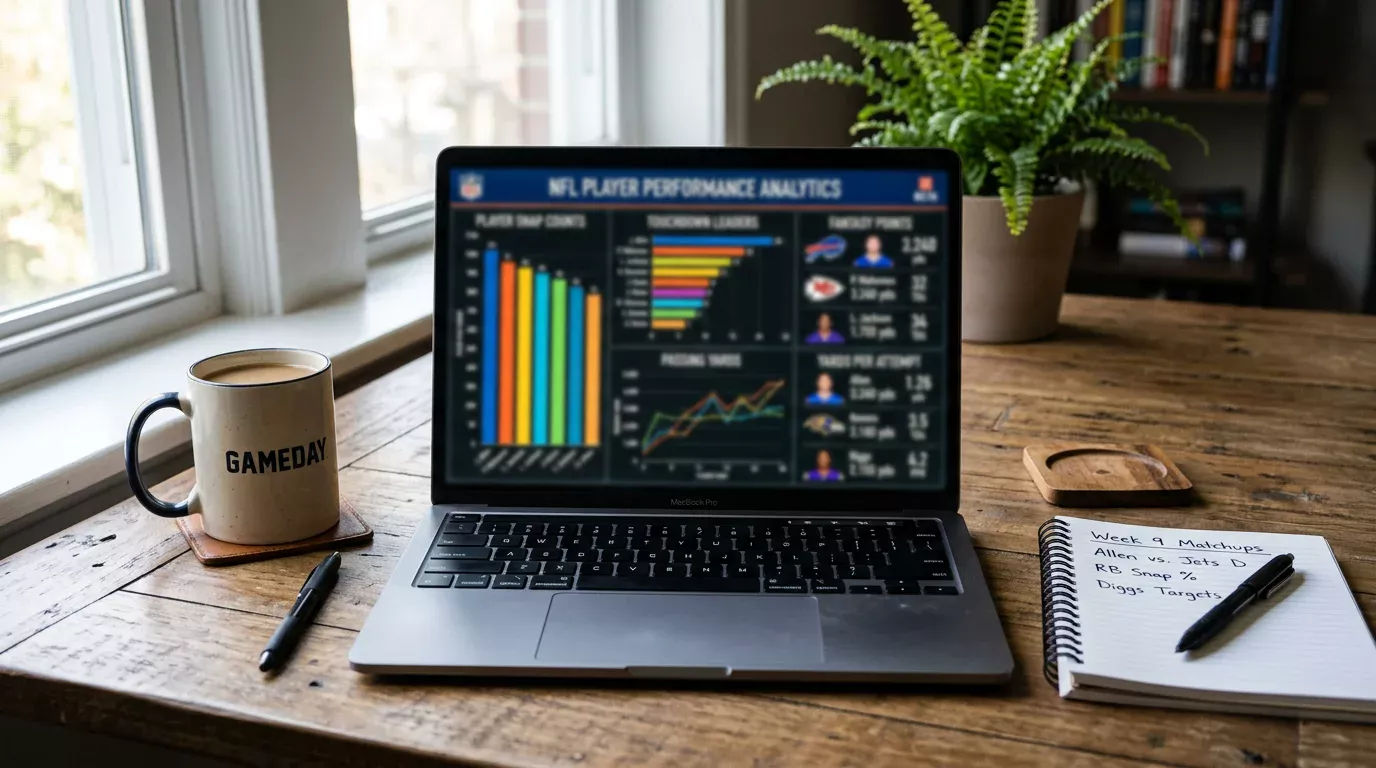
The single biggest upgrade to my NFL betting came not from a new strategy or a clever staking plan but from changing where I got my data. For years I was building picks from box scores and basic team stats — points per game, yards per game, turnover differential. The kind of numbers you find on any free sports site. Then a fellow punter showed me his process: he was pulling expected points added per play, success rate by down and distance, and defensive DVOA splits, and suddenly the gap between his analysis and mine was obvious. I was reading headlines. He was reading the story underneath.
NFL betting is a data-rich discipline. Genius Sports holds an exclusive multi-year deal with the NFL to distribute official real-time data through to Super Bowl 2030 — a contract originally valued at $120 million over six years, since renewed and expanded. That data powers the lines your bookmaker sets. If you want to find value in those lines, you need access to the same quality of information, or as close to it as the public can get.
The Official NFL Data Pipeline
Every play in every NFL game generates a data record. The snap time, formation, personnel grouping, route combinations, throw distance, yards after catch, tackle location, time to pressure — all of it captured and timestamped. Genius Sports aggregates this data and distributes it to licensed bookmakers, media partners and analytics providers. The speed of that distribution matters: bookmakers receive in-play data feeds with latency measured in fractions of a second, which is why live NFL odds move faster than any human can process.
As a UK punter, you do not have access to the raw Genius Sports feed. It is a commercial product priced for institutional clients. What you do have access to is the downstream analytics built on that data by public-facing providers, and that is more than enough to build a serious betting framework.
The NFL’s own website publishes play-by-play data, box scores and basic advanced stats with a delay of a few hours after each game. NFL Next Gen Stats, powered by tracking chips in every player’s shoulder pads, provides route charts, separation metrics, passing windows and rushing lanes. This data is free, updated weekly, and highly useful for prop betting and player-level analysis. I use Next Gen Stats every week to evaluate quarterback accuracy under pressure and receiver separation — two metrics that correlate strongly with passing prop outcomes.
Free and Paid Analytics Tools
Pro Football Reference is where I start every research session. It is free, comprehensive, and covers every season back to 1920. For betting purposes, the most valuable sections are the team and player game logs, the advanced passing and rushing tables, and the splits pages that let you filter by home/away, indoor/outdoor, rest days and opponent strength. I have bookmarked roughly 15 specific PFR pages that I check every Tuesday when the previous week’s data is fully loaded.
Football Outsiders publishes DVOA — Defence-adjusted Value Over Average — which remains one of the most respected composite metrics in NFL analytics. DVOA measures every play against a baseline adjusted for opponent, down, distance and game situation. A team with a 15% offensive DVOA is performing 15% better than the league average after adjusting for schedule. I find DVOA most useful for totals betting and first-half analysis, where offensive and defensive efficiency drive scoring pace more directly than raw points-per-game averages.
Expected Points Added (EPA) has become the lingua franca of modern NFL analytics. Available through open-source tools like nflfastR (built in R) and nfl_data_py (built in Python), EPA assigns a point value to every play based on the change in expected points from before the snap to after the whistle. EPA per play is the single metric I rely on most heavily for spread analysis. A team averaging 0.15 EPA per dropback against a defence allowing 0.20 EPA per dropback has a quantifiable passing-game edge that translates directly into spread value.
PFF — Pro Football Focus — is the main paid option. A subscription runs between 30 and 50 pounds per year depending on the tier, and what you get is individual player grades for every snap, coverage metrics, pass-blocking efficiency scores and matchup-specific data that is difficult to find elsewhere. I consider PFF worth the cost if you bet player props regularly, because the granularity of their grading system lets you identify mismatches — a receiver facing a cornerback who has allowed a 120+ passer rating in coverage, for example — that prop markets sometimes underprice.
For weather data, I use a combination of the National Weather Service forecasts and stadium-specific weather trackers. Wind speed, temperature and precipitation all affect totals markets, particularly in open-air stadiums during November and December. A 20-mph crosswind at Soldier Field does not show up in any analytics platform, but it can knock three to five points off a game total.
Turning NFL Data Into UK Betting Decisions
Data without a framework is noise. I learned this the hard way when I spent an entire preseason building a model with 40 input variables and discovered that it performed no better than a coin flip against the spread. The problem was overfitting — I had given the model so many inputs that it was memorising past results rather than identifying predictive patterns.
The framework I use now is deliberately simple. For spread bets, I look at three things: EPA per play differential (offence minus defence), turnover-adjusted scoring margin over the last six games, and rest/schedule context (short week, travel, divisional rivalry). Those three inputs, weighted equally, produce a projected spread that I compare to the bookmaker’s line. If my projection differs by more than 1.5 points, I have a potential bet. If it differs by less, I pass.
For totals, I focus on pace (plays per game) and efficiency (EPA per play for both offences and defences involved), adjusted for venue and weather. Dome games get a small upward adjustment; outdoor games in December in the Northeast get a downward one. The model is simple enough to update in 20 minutes per game, which means I can process an entire 16-game Sunday slate before the early window kicks off at 6pm UK time.
The key insight for UK punters is that you do not need proprietary data or a supercomputer. The publicly available analytics are more than sufficient to identify value against bookmaker lines, particularly on secondary markets like weekly NFL picks where the bookmaker’s attention is spread thinner. What you do need is consistency: pulling the same data every week, updating the same models, and trusting the process over a full season rather than abandoning it after two bad Sundays.
Start with Pro Football Reference and EPA data from nflfastR. Add PFF if you bet props. Check weather before every outdoor game. That combination covers 90% of the data you need to make informed NFL bets from the UK, and every bit of it is available before the lines move on Sunday morning.
Do I need paid NFL analytics subscriptions to bet profitably?
No. The free tools — Pro Football Reference, nflfastR for EPA data, NFL Next Gen Stats and Football Outsiders for DVOA — provide more than enough analytical depth for profitable spread, totals and futures betting. Paid subscriptions like PFF add value for player prop analysis specifically, but they are not required for a profitable NFL betting approach.
How quickly after NFL games do advanced stats become available?
Basic box scores and play-by-play data are available within an hour of a game finishing. EPA and DVOA metrics are typically updated by Tuesday. PFF grades appear within 24-48 hours. Next Gen Stats tracking data is published weekly. For betting purposes, Tuesday to Thursday is the window when the previous week’s data is fully processed and the next week’s analysis can begin.
Written by the editors at nfl Sports bet.