NFL Game Props Betting: Coin Toss, First Score Method and Team-Level Markets
 Available in US
Super Bowl LVIII generated more than $23 billion in total wagering, and a startling proportion of that money landed on markets that had nothing to do with who would win the game. Coin toss. First score method. Colour of the Gatorade shower. Game props — bets on events within a match rather than on individual player performances — have exploded from a novelty sidebar into a serious category of NFL wagering. I placed my first game prop bet in 2019 on whether the opening drive of a Thursday night game would result in a touchdown. I won, mostly by luck, but the experience opened my eyes to a corner of the market where bookmaker pricing is often less rigorous than on spreads and totals.
Game props differ from player props in one fundamental way: they are tied to match events rather than individual statistics. You are not betting on a quarterback’s passing yards or a running back’s touchdowns — you are betting on structural outcomes like winning margins, half-time scores, scoring sequences and situational events. That distinction matters because game props are harder for bookmakers to model precisely, which creates pockets of value for punters who understand game flow.
Types of NFL Game Props
The first time I scrolled through the full game props menu for a Super Bowl, I counted over 400 individual markets. That was three years ago; the number has only grown since. But most of those markets cluster into a handful of categories, and understanding the categories is more useful than memorising every exotic bet.
Scoring props form the largest group. These include first team to score, last team to score, first scoring method (touchdown, field goal, safety), race to a specific point total (first to 10, first to 20), and whether a specific quarter will be the highest-scoring period. Each of these has a distinct pricing logic. First team to score, for instance, is heavily influenced by who receives the opening kickoff and their red zone efficiency — data points that are publicly available and frequently mispriced in early-season games when sample sizes are small.
Margin props let you bet on the exact winning margin or margin bands: 1-6 points, 7-12, 13-18, and so on. These are popular during the Super Bowl, where the AGA projected $1.76 billion in wagers for Super Bowl LX alone. Margin bands require you to think about game script — a one-score game in the fourth quarter is more likely to finish within a 1-6 margin than a blowout that triggers garbage time, which often compresses the final margin back toward a single-score difference.
Half and quarter props divide the game into segments. You can bet on the first-half spread, the first-half total, the highest-scoring quarter or whether the second half will produce more points than the first. These are among the sharpest game props available because bookmakers can derive first-half lines from their full-game models with reasonable accuracy. The edge here is narrower, but it exists — particularly in games where one team’s offence starts slowly due to scripted early-game play-calling that differs from their second-half approach.
Novelty props are the coin toss, the Gatorade colour, the length of the national anthem. These are entertainment bets with no analytical edge whatsoever. The coin toss is a genuine 50/50, and the bookmaker’s margin means you are guaranteed negative expected value. I have bet the coin toss exactly once, for a single pound, and I consider it a donation to the entertainment fund.
Pricing and Margin Reality
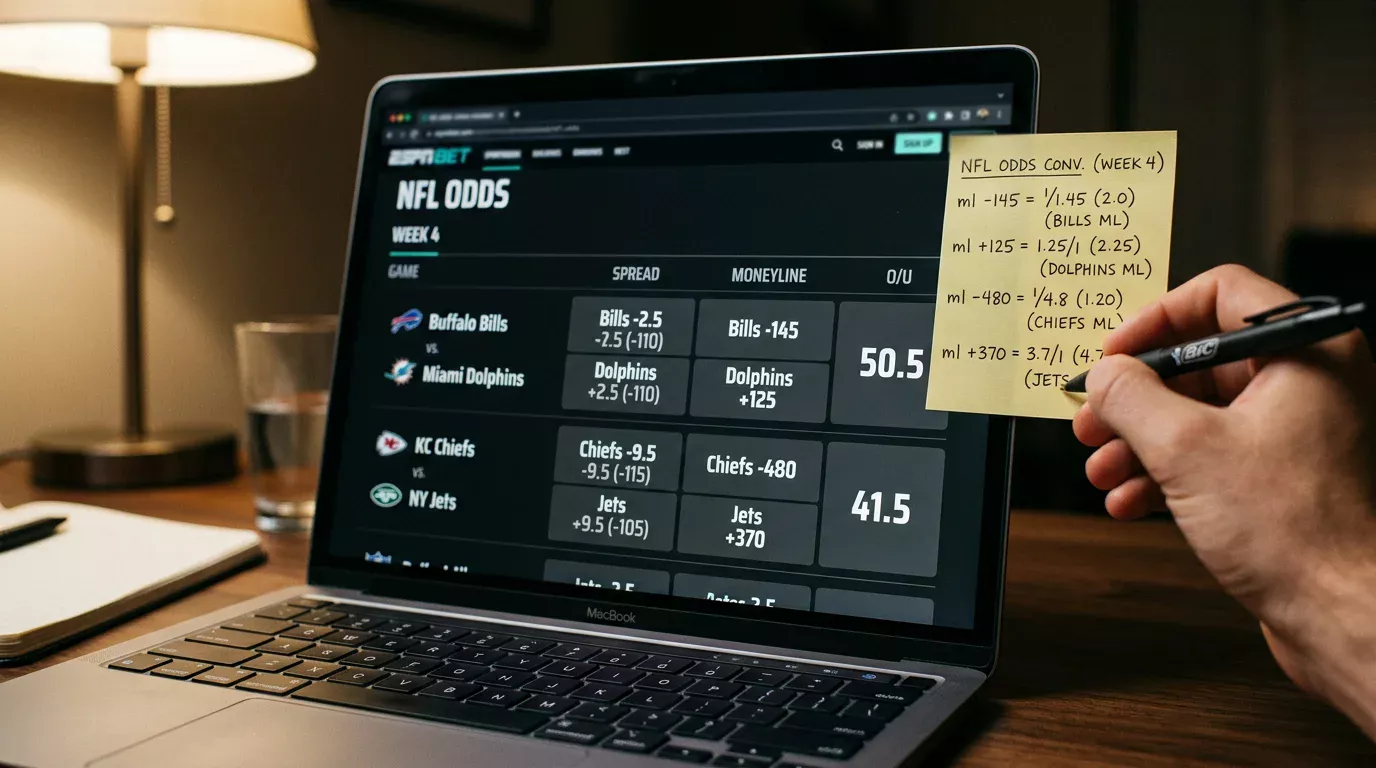
Last November I compared the margins on game props versus standard markets across three UK bookmakers for a single NFL Sunday slate. The results confirmed what I had suspected: the average overround on spread markets was 4.6%, on totals it was 4.8%, and on game props it ranged from 7% to 18% depending on the market type. Margin props and novelty props carried the widest margins; first-half spreads and totals were closest to the standard market pricing.
That margin gap is the cost of playing in less liquid markets. Bookmakers know that game props attract recreational bettors who are betting for fun rather than value, and they price accordingly. The lower the expected volume on a market, the wider the margin — because the bookmaker needs to protect against the risk of one-sided action on a thinly traded line.
This does not mean game props are always bad bets. It means you need a larger edge to overcome the higher margin. On a standard spread bet with a 4.5% overround, you need to be right roughly 52.4% of the time to break even. On a game prop with a 12% overround, that threshold rises to about 56%. The maths is unforgiving, and it is why I concentrate my game prop betting on the categories where my analysis can generate a genuine information advantage rather than spreading small stakes across dozens of novelty markets.
Game Script Strategies That Work
The most profitable game prop I have found over the past three seasons is the “both teams to score in every quarter” market, priced as a yes/no bet. Bookmakers typically set the “no” at short odds because it is the more likely outcome — most NFL games have at least one scoreless quarter for one side. But the pricing on “yes” is frequently generous in matchups between two high-scoring offences with strong red zone efficiency, particularly in dome games where weather is not a factor.
I track this by looking at each team’s scoring rate by quarter over the previous eight games. If both teams have scored in every quarter at least 60% of the time during that window, and the total is set above 48.5, the “yes” price often offers value. It is a niche strategy, but niche is exactly where game props reward homework.
Another approach that has paid off: first-half unders in games where both teams are run-heavy and coming off a bye week. Bye weeks produce lower first-half scoring on average because coaches install new wrinkles that take time to execute, and early drives tend to be more conservative. The full-game total reflects the overall expected scoring, but the first-half total sometimes fails to account for the slower start. I have tracked this across 40 post-bye matchups and found the first-half under hitting at 58% when both teams rank in the top 12 for rushing attempts per game.
Game props reward specificity. The punters who lose money on them are the ones treating the market like a lottery — scattering small stakes across 15 different props and hoping something lands. The punters who profit are the ones who identify two or three markets per week where their research creates a measurable edge over the bookmaker’s pricing, and who have the discipline to ignore the rest.
When Game Props Deserve Your Attention
I bet game props selectively. During the regular season, I might place one or two per week on first-half totals or margin bands in matchups I have studied closely. During playoff weekends, the volume increases because the props market deepens and the pricing becomes more competitive — more money flows in, which tightens margins slightly and creates more two-way action.
Super Bowl week is the one time of year I actively scan the full game props menu, because the sheer volume of available markets means bookmakers are pricing hundreds of lines simultaneously and cannot give each one the attention it deserves. That is where the mispricings live — not on the headline markets, but on the obscure scoring sequence props and quarter-specific lines that attract less scrutiny.
If you are new to game props, start with first-half spreads and totals. They behave like miniature versions of full-game markets, the margins are reasonable, and your existing NFL knowledge transfers directly. Leave the coin toss and the Gatorade colour to the casual punters who are betting for a laugh. There is nothing wrong with entertainment betting, but if you are reading this article, you are looking for an edge — and game props can provide one, if you know where to look.
Are NFL game props available for every regular-season game at UK bookmakers?
Major UK bookmakers offer game props for most NFL games, but the depth of the menu varies by match. Primetime games — Thursday Night Football, Sunday Night Football and Monday Night Football — typically have the widest selection, often 50 or more game prop markets. Early-window Sunday games may have fewer options, sometimes limited to half-time spreads, totals and basic scoring props.
Can I include game props in a bet builder or accumulator?
Most UK bookmakers allow game props in bet builders and same-game multis, though not all prop types qualify. Half-time spreads, totals and first scoring method are commonly included. Novelty props like the coin toss are usually excluded from multi-bet combinations. Check your bookmaker’s bet builder rules, as restrictions vary by operator.
Prepared by the nfl Sports bet editorial staff.