NFL Odds Conversion: Formulas, Worked Examples and a Quick Reference Table
 Available in US
The first time I tried to follow an NFL betting discussion on an American podcast, I truly thought they were speaking a different language. Minus one-ten. Plus two-twenty. Three-point underdog at minus one-oh-five. I had spent years reading fractional odds on UK bookmaker sites and understood those instinctively — but the American format felt like someone had taken a perfectly clear system and deliberately obscured it. That frustration lasted about a week before I sat down and worked through the conversions properly, and once I did, the whole thing clicked in about ten minutes.
If you are a UK punter following NFL markets, you will encounter American odds constantly: on social media, in US-published analysis, on podcasts, in line movement trackers. With 78% of all sports wagering now happening on mobile devices, you are probably flicking between British bookmaker apps showing fractional or decimal odds and American content showing moneylines and spreads in their native format. Being fluent in all three is not optional — it is the price of entry for anyone serious about finding value across markets.
American Odds Decoded
I remember the exact moment American odds stopped confusing me. I was staring at a Kansas City Chiefs line of -150 and asked myself one question: what does this number actually represent? The answer is beautifully simple once you hear it.
A negative American number tells you how much you need to stake to win 100 units. Chiefs at -150 means you stake 150 to win 100. A positive number tells you how much you win from a 100-unit stake. An underdog at +200 means a 100-unit stake returns 200 in profit. That is the entire system. Everything else is arithmetic.
For UK punters, the confusion usually comes from the asymmetry. Negative odds describe stake-to-win, positive odds describe win-from-stake. Once you internalise that split, you can read any American line instantly. Chiefs -7 at -110 means they are seven-point favourites, and you need to stake 110 to win 100 on that spread. The -110 is the price; the -7 is the handicap. Two separate pieces of information that Americans often present together without explaining either.
A practical shortcut for matchday: -110 is the standard American price on a spread or total, equivalent to roughly 10/11 in fractional or 1.91 in decimal. Any time you see -110, think 10/11. That single conversion covers the majority of NFL spread and totals betting, because -110 is the default vig on both sides of a standard line.
Fractional and Decimal Conversion
Three years ago I built a simple spreadsheet that converts between all three formats. I still use it every week, but the formulas are simple enough to do in your head for common NFL prices.
To convert negative American odds to decimal: divide 100 by the absolute value of the American number, then add 1. So -150 becomes (100 / 150) + 1 = 1.67. To convert positive American odds to decimal: divide the American number by 100, then add 1. So +200 becomes (200 / 100) + 1 = 3.00.
Decimal to fractional is even simpler: subtract 1 from the decimal, then express the result as a fraction. Decimal 1.67 becomes 0.67, which is 67/100 or roughly 2/3. Decimal 3.00 becomes 2/1. For clean NFL prices, the conversions are neat. For messier numbers, rounding to the nearest common fractional odds is fine for quick mental maths — precision matters when you are calculating expected value, not when you are scanning a market.
Here are the NFL prices you will see most often, already converted:
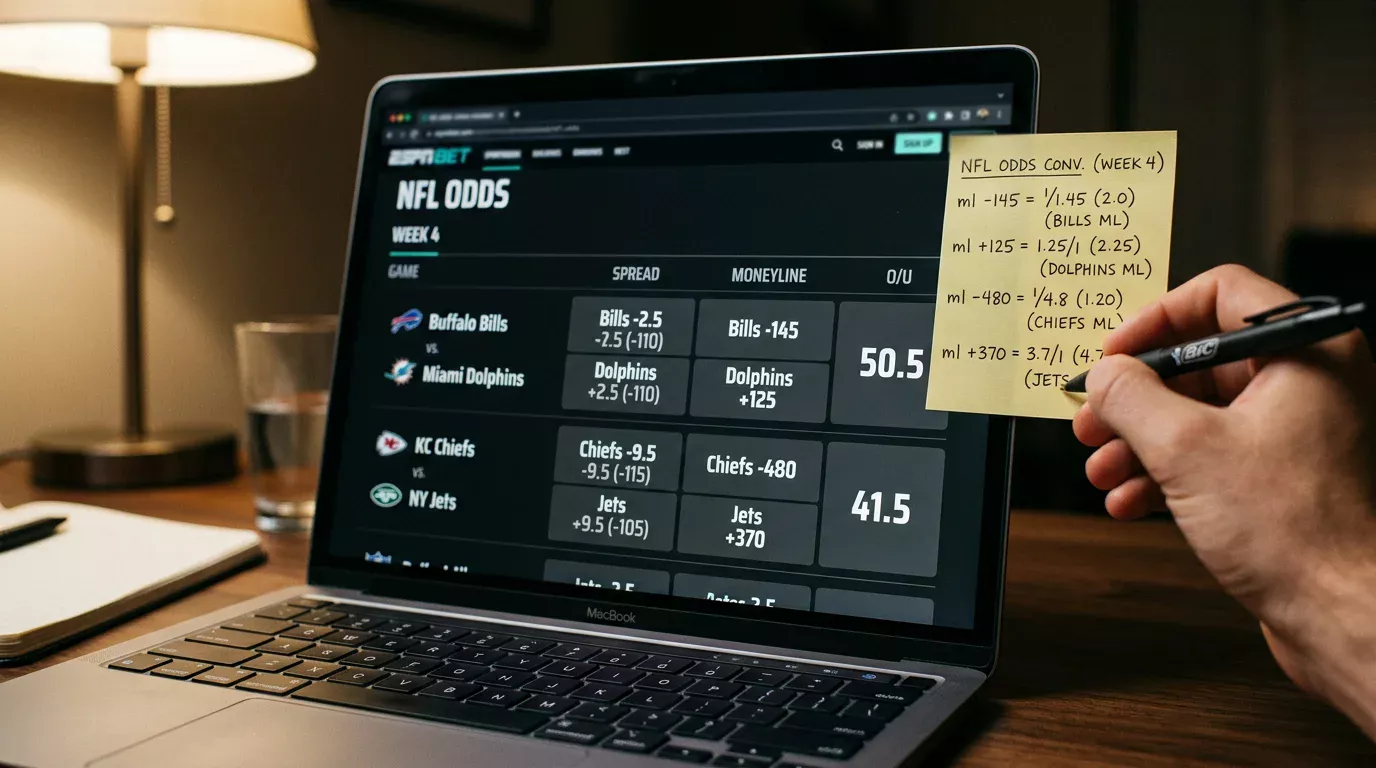
American -110 equals decimal 1.91 equals fractional 10/11. American -150 equals decimal 1.67 equals fractional 4/6. American +150 equals decimal 2.50 equals fractional 6/4. American +200 equals decimal 3.00 equals fractional 2/1. American -200 equals decimal 1.50 equals fractional 1/2. American +300 equals decimal 4.00 equals fractional 3/1. American -300 equals decimal 1.33 equals fractional 1/3.
Memorise those seven and you cover roughly 80% of the prices you will encounter in NFL spread, moneyline and totals markets. The rest you can calculate or look up. Most UK bookmaker apps now offer a toggle between fractional and decimal display, but none of them show American format natively — so the conversion from American to your preferred UK format is the skill that actually matters.
Implied Probability and Why It Matters More Than the Number
Last season I found a discrepancy between two bookmakers on a Thursday Night Football game that I would have missed entirely if I had been looking at odds rather than implied probabilities. One site had the favourite at 4/7 and the other at -160. Those look different at a glance. They are not. Both imply roughly the same probability — about 61.5% — but the decimal conversions revealed that one was 1.57 and the other 1.625. That 0.055 difference in decimal odds represented genuine value on a market I would otherwise have treated as identical.
Implied probability is the language that makes all three odds formats comparable. The formula from decimal odds: implied probability equals 1 divided by the decimal price. So 1.91 implies 1/1.91 = 52.4%. From American: for negative odds, divide the absolute value by (absolute value + 100). So -150 implies 150/250 = 60%. For positive odds, divide 100 by (American odds + 100). So +200 implies 100/300 = 33.3%.
The crucial insight is that bookmaker odds always overstate the total implied probability beyond 100% — that excess is the overround, the bookmaker’s margin. A standard NFL spread market priced at -110 on both sides implies 52.4% + 52.4% = 104.8%. That 4.8% overround is the tax you pay for the privilege of betting. When you compare NFL odds across UK bookmakers, converting everything to implied probability and measuring the overround is the fastest way to identify which operator is offering the sharpest price.
I calculate implied probability for every NFL bet I place. It takes five seconds and it reframes the decision from “do I like these odds” to “do I believe this team’s true probability of winning exceeds what the bookmaker is pricing.” That reframing is the foundation of value betting, and it works identically regardless of whether the original price was displayed as 5/4, 2.25 or +125.
Putting Conversion to Work on Game Day
Every Sunday morning during the NFL season, I spend about twenty minutes scanning American odds movement from overnight trading in the US, then comparing those prices to what UK bookmakers are offering. The workflow is simple: note the American closing line on a key market — say, Bills -3 at -108 — convert to decimal (1.93), check three UK books for the same market, and see if any of them are offering 1.95 or better. A two-tick difference on a standard spread bet translates to meaningful expected value over a full season.
The conversion itself is mechanical. The advantage it creates is strategic. American odds move first because the US market is deeper and sharper — NFL handle in the US exceeded $30 billion in the most recent full season. UK bookmakers adjust their lines in response, but there is often a lag, especially on early-morning markets and less popular matchups. If you can read both formats fluently, you can spot those windows before they close.
Do not overthink the arithmetic. Learn the seven common conversions above, understand implied probability, and use a calculator or spreadsheet for anything unusual. The goal is not to become a human conversion engine — it is to stop letting format differences prevent you from seeing value.
Why do American odds use negative and positive numbers instead of fractions?
American odds evolved from a money-line system where the baseline is always 100 units. Negative numbers show what you risk to win 100; positive numbers show what you win from risking 100. The format makes it easy to see the favourite (negative) and underdog (positive) at a glance. It is functionally identical to fractional and decimal odds — just a different way of expressing the same probability and payout.
Do UK bookmakers ever display American odds on NFL markets?
No major UK bookmaker uses American odds as a default display. Most offer a choice between fractional and decimal formats in their app settings. If you want to see American odds, you will need to use a US-facing odds comparison site or a dedicated conversion tool. Learning to convert manually remains the most reliable approach for UK punters who follow American analysis.
Written by the editors at nfl Sports bet.