NFL Moneyline Betting: When Backing the Outright Winner Beats the Spread
 Available in US
I once turned down a +260 moneyline on the New York Giants before their 2023 upset of the Philadelphia Eagles because I “knew” the Eagles were the better team. The Giants won outright. My confidence in the spread was irrelevant — the moneyline paid nearly three times the stake, and I left the value sitting on the table because I defaulted to the market I understood rather than the market that offered the best price.
The moneyline is the simplest NFL bet available: pick which team wins the game. No points, no spreads, no handicaps. Yet simplicity does not mean the moneyline lacks strategic depth. Knowing when to back the outright winner rather than taking the spread is a skill that separates punters who react to odds from punters who exploit them.
How NFL Moneyline Odds Reflect Win Probability
Every moneyline price is a translation of implied probability, and the gap between the implied probability and the actual probability is where the bookmaker earns its margin. The average hold rate across American sportsbooks has grown from 6.7% to above 9% in recent years, and moneyline markets are not immune to that inflation. Understanding the mechanics behind the numbers protects you from overpaying.
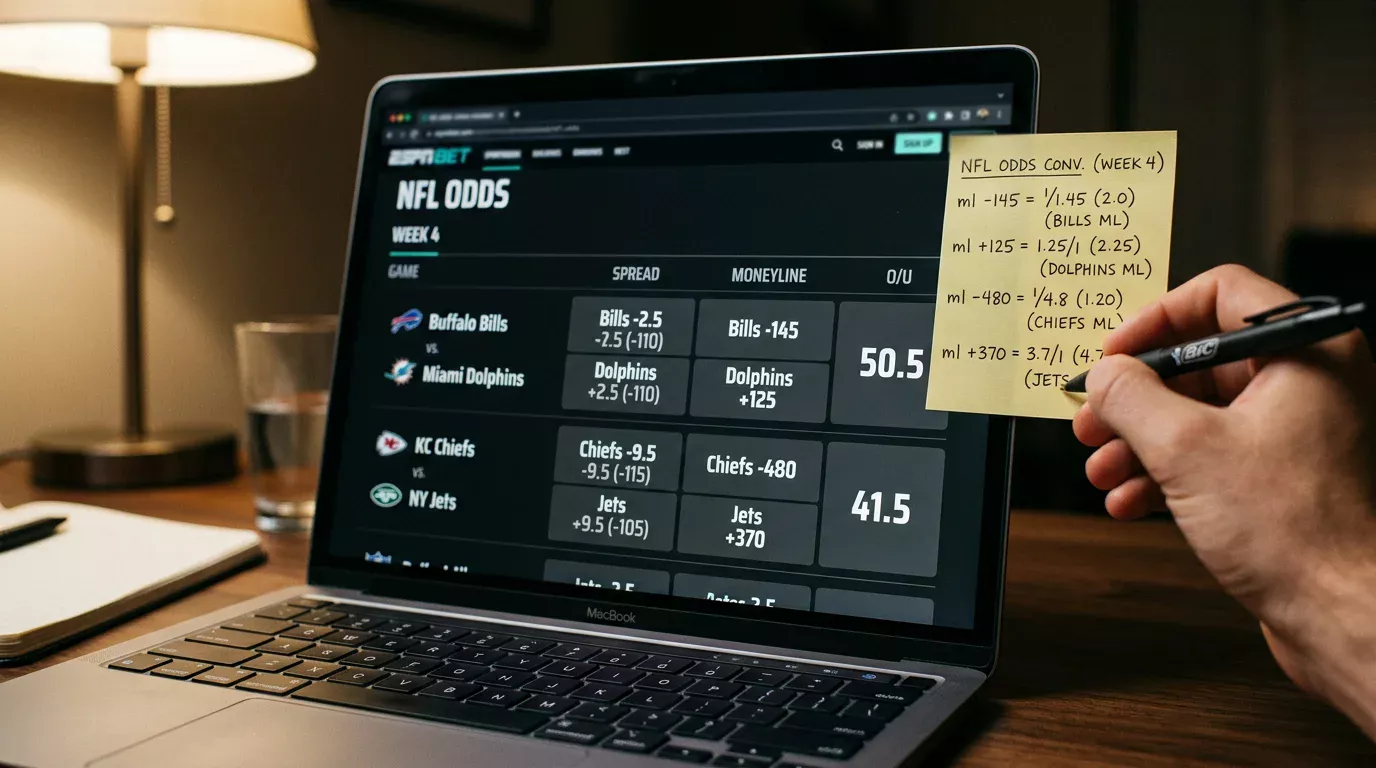
A favourite listed at -200 (1/2 in fractional odds) carries an implied probability of 66.7%. An underdog at +200 (2/1) implies 33.3%. Added together, those probabilities total 100% — but bookmakers never offer a perfectly fair book. In practice, the favourite might be -220 and the underdog +180, producing a combined implied probability of 110.2%. That extra 10.2% is the overround, and it is the house’s built-in edge on every moneyline market.
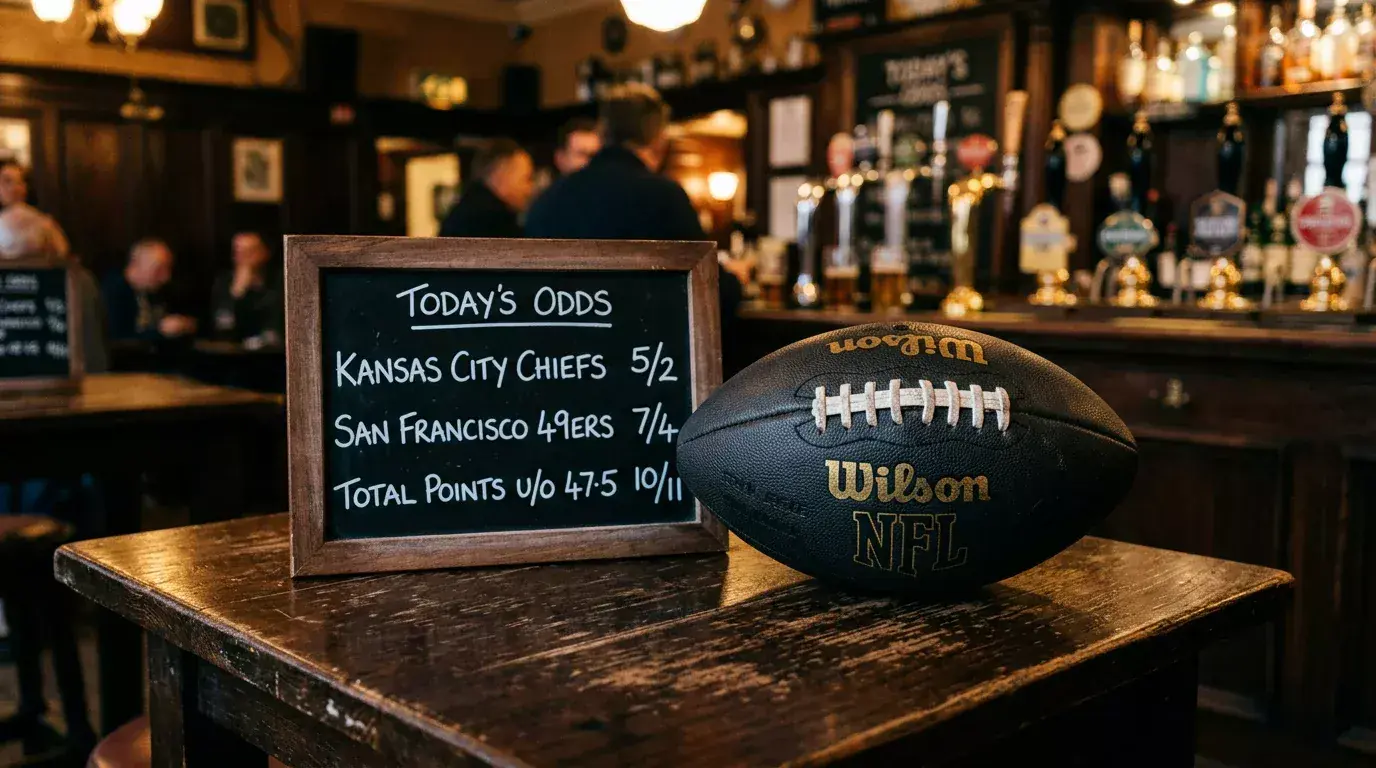
For UK punters, fractional odds make the overround harder to spot at a glance. A moneyline favourite at 4/9 and an underdog at 15/8 do not scream “10% margin” the way American odds do when you run the arithmetic. Converting both to implied probability — 69.2% and 34.8%, totalling 104% — reveals the margin immediately. This conversion step takes thirty seconds and should become automatic before placing any moneyline wager.
The NFL generates roughly $30 billion in total handle each season across all markets, and that enormous liquidity means moneyline prices are generally efficient — but not perfectly so. Efficiency breaks down at the extremes: heavy favourites beyond -300 and long underdogs past +300 tend to be priced less accurately because fewer sharp bettors operate in those ranges. That is where edge lives, if you know how to find it.
Scenarios Where the Moneyline Offers Better Value Than the Spread
Last season, I tracked every game where the spread was -1.5 or -2.5 and compared the expected value of betting the spread versus the moneyline. The results surprised me. In games with tight spreads, the moneyline on the favourite was often a mathematically superior bet because the price difference between -1.5 on the spread and a -130 moneyline was smaller than the probability gap between covering by two points and simply winning.
The crossover point typically sits around spreads of -3 to -4.5. Below -3, the moneyline favourite offers comparable or better value than the spread because the favourite only needs to win — by a single point counts. Above -6.5, the spread underdog often provides better value because the underdog receives enough points to cover even in a loss, while the moneyline underdog price at those ranges tends to underestimate the actual upset probability.
Teasers and NFL spread betting dominate the conversation among UK punters, but the moneyline deserves attention in three specific situations. First, when the spread sits on a key number like -3 and you believe the favourite wins but the margin is unpredictable. Second, when an underdog’s moneyline price implies a win probability significantly below your own assessment. Third, in playoff games, where underdogs win outright more often than regular-season data suggests because talent compression tightens the field.
Underdog Moneyline Strategy: Small Edges in Big Prices
The beauty of underdog moneylines is that you do not need to win often. A punter who backs +200 underdogs and wins 35% of the time is printing money — the break-even point at 2/1 is 33.3%. The challenge is identifying which underdogs have a genuine 35% chance when the market says 33%.
Home underdogs are the most fertile ground. NFL home teams enjoy a tangible advantage from crowd noise, travel avoidance, and familiarity with the playing surface. When a home team is listed as an underdog, the market is signalling that the visiting team is substantially better — but the home-field benefit compresses the gap. Over multi-season samples, home underdogs win outright at rates that exceed the implied probability baked into their moneyline prices.
Divisional underdogs follow a similar pattern. Teams within the same division play each other twice a year, and familiarity breeds competitiveness. The Baltimore Ravens might be a far superior team to the Cleveland Browns on paper, but the second divisional meeting of the season often produces tighter results than the overall talent gap would predict. Divisional underdogs at +150 to +250 represent a consistent hunting ground for moneyline value, provided you avoid the trap of backing genuinely outclassed teams simply because they happen to share a division with the favourite.
Bankroll sizing matters enormously on underdog moneylines. Because your strike rate will be low — 30% to 40% at best — the losing streaks are longer and more psychologically demanding than spread betting. I cap individual underdog moneyline stakes at 1% of my bankroll. The returns when they hit compensate for the frequency of losses, but only if your bankroll survives the dry spells intact.
When the Moneyline Is a Trap Worth Avoiding
Not every moneyline bet makes sense, and the worst trap is backing heavy favourites at short prices. A -400 favourite (1/4 in fractional) must win 80% of the time to break even. The actual win rate for teams priced at -400 or shorter hovers around 78% to 82% over large samples, which means the expected profit after accounting for the overround is essentially zero — and any run of variance puts you deep in the red.
I learned this through a stretch in 2022 where I backed four consecutive heavy NFL favourites on the moneyline, all at prices shorter than -300. Three of the four won. My net return across all four bets was negative because the single loss wiped out the tiny profits from the three winners. The maths are unforgiving at those odds: one upset in every five bets erases all accumulated gains.
The discipline is simple. Favour the moneyline when the price reflects a genuine edge, and favour the spread when the moneyline price offers only the illusion of safety. A team at -150 that you believe should be -120 is a value moneyline. A team at -350 that you believe should be -300 is not — the margin of safety is too thin relative to the stake required.
Is it ever worth backing a heavy NFL moneyline favourite?
Rarely. Favourites priced at -300 or shorter need to win at least 75% of the time just to break even, and the actual win rate at those prices is usually only marginally above that threshold. A single upset wipes out several winning bets. If you believe the favourite wins, the spread or an alternate line often provides better risk-adjusted value.
How does overtime affect moneyline bets in the NFL?
NFL moneyline bets include overtime. If a game goes to OT, the team that ultimately wins the game wins your moneyline bet. There is no separate settlement for regulation time versus overtime on standard moneyline markets at UK bookmakers. Some bookmakers offer a regulation-time moneyline as an alternative market, which excludes OT and is graded as a push if the game is tied after 60 minutes.
Created by the ”nfl Sports bet” editorial team.