NFL Line Movement: Tracking Sharp Bets and Price Closers
 Available in US
In October 2023, I watched a line move from -3 to -1 in the space of forty minutes on a Tuesday morning, with no injury news, no weather change, and no public information to explain it. Three days later, the starting quarterback for the favoured team was placed on the injury report with a knee issue that had apparently been known to insiders earlier in the week. That moment crystallised something I had suspected for years: NFL line movement tells a story, and the people writing the first chapters often know things the rest of us do not.
Genius Sports holds an exclusive multiyear contract with the NFL to distribute official league data, a deal that underpins the pricing models of every major bookmaker worldwide. That data pipeline ensures the lines start from an informed baseline. But between the opening number and the closing number — sometimes a gap of five full days for a Sunday game — the line absorbs information from injury reports, weather forecasts, betting volume, and the concentrated action of professional bettors. Understanding that journey from opener to closer is one of the most valuable skills a UK punter can develop.
Tracking sharp money becomes much easier once you know how to accurately read and convert NFL betting odds across different bookmakers.
Opening Lines Analytics: Identifying Early Bookmaker Price Drivers
There is a widespread myth that opening lines are designed to attract equal money on both sides. They are not. Opening lines are the bookmaker’s best estimate of the true probability of each outcome, informed by power ratings, historical data, and algorithmic models. The goal at the opening stage is accuracy, not balance. Balance comes later, as the market reacts.
Most NFL opening lines appear on Sunday evening or Monday morning for the following week’s games. The market-making bookmakers — the ones that set the initial number rather than copying it from elsewhere — use proprietary models that weigh offensive and defensive efficiency, home-field advantage (which has declined significantly in recent years but still exists), rest days, travel distance, and a range of other variables. These models are good. They are not, however, omniscient.
The vulnerability of opening lines lies in what the models cannot yet incorporate. The official injury report does not appear until Wednesday. Weather forecasts for Sunday games are unreliable before Thursday. And coaching decisions — game plans, scheme adjustments, personnel groupings — are invisible until the teams take the field. Every piece of information that emerges between the opening line and kick-off is a potential catalyst for movement, and the punters who act on that information first capture the most value.
For UK punters, the practical implication is timing. If you have strong views on a game and the opening line aligns with your analysis, there is rarely a benefit to waiting. The line will either move toward your position (reducing your value) or away from it (increasing your value but also suggesting the market disagrees with you). I default to betting early when I have conviction and waiting only when I need additional information — typically the Wednesday injury report — to finalise my view.
Sharp Money vs Public Money: Reading the Movement
Not all money moves lines equally. A single large wager from a known sharp bettor — a professional who has demonstrated long-term profitability — carries more weight with the bookmaker than a hundred small bets from recreational punters. Bookmakers track betting accounts, categorise them by historical performance, and adjust their lines more aggressively when money arrives from accounts flagged as sharp. This is the mechanism behind the most important concept in line movement: the difference between sharp action and public action.
The US sports betting market processed $165.58 billion in total handle during 2025. The sheer volume means that most of the money on any given NFL game comes from recreational bettors — people placing five or ten-pound bets on their preferred team, loading up accumulators, or backing the name they recognise. This recreational volume is predictable: it gravitates toward favourites, overs, and popular teams. Bookmakers anticipate this flow and set their opening lines accordingly, which means the line often already accounts for expected public money before a single bet is placed.
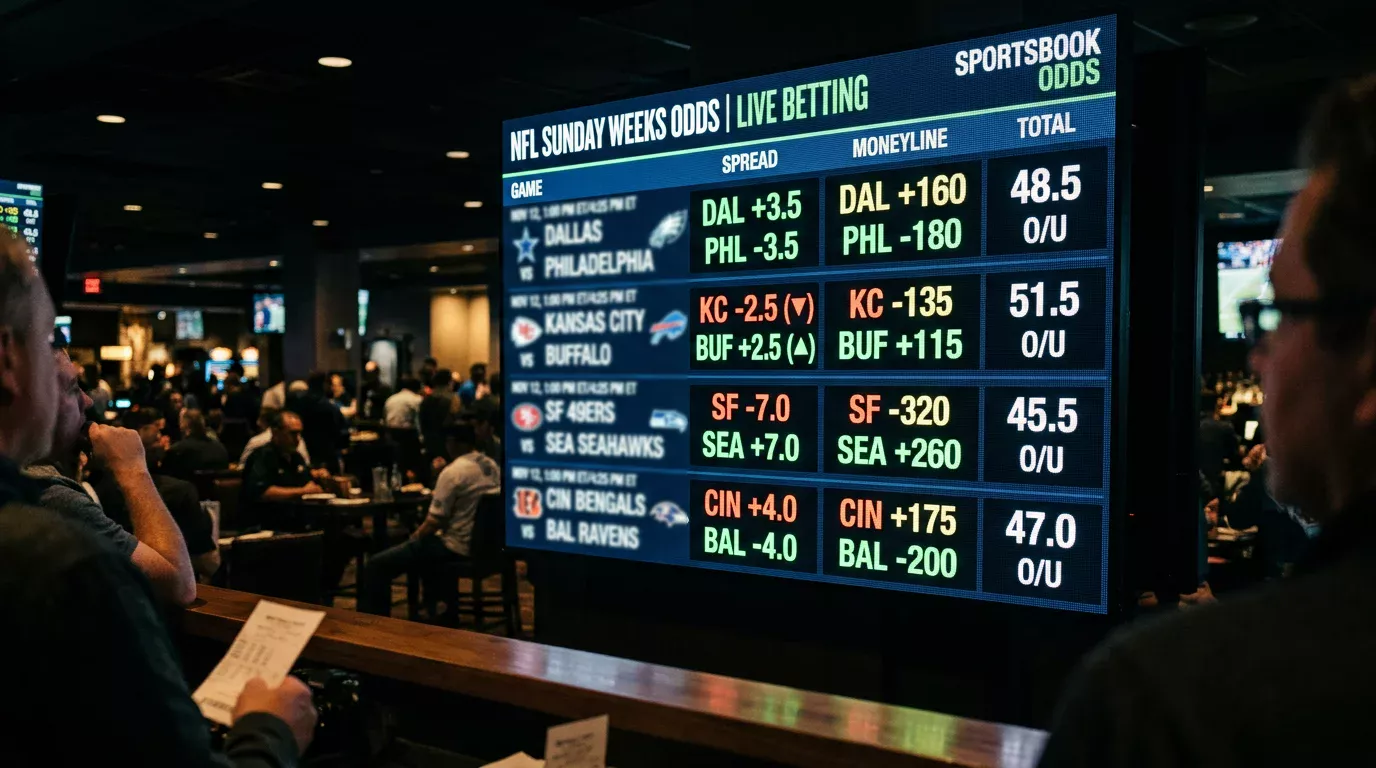
Sharp money, by contrast, is unpredictable in direction and concentrated in timing. A sharp bettor might wait until Wednesday afternoon to place a significant wager on the underdog, triggering a line move that catches recreational bettors off guard. When you see a line move against the expected public direction — say, the popular favourite drifts from -7 to -6 despite heavy public backing — that is usually a signal of sharp action on the other side. The bookmaker is responding not to the volume of bets but to the source of specific bets.
Learning to read these movements across UK bookmaker platforms requires tracking lines from their opening throughout the week. Several free websites publish line-movement data for NFL games, showing the opening number, the current number, and the direction of travel. I check these at least twice daily during NFL season — once in the morning and once in the evening — to identify games where the line is moving contrary to public expectation.
Monitor real-time line shifts and market trends directly on the GRIDBET homepage.
Reverse Line Movement: When the Line Goes Against the Crowd
Reverse line movement is the single most talked-about concept in NFL betting analysis, and it is also the most frequently misunderstood. The basic definition is simple: the line moves in the opposite direction of the majority of bets. If 70% of bets are on Team A at -3, but the line moves to -2.5, the public is backing Team A while the line is moving toward Team B. That is reverse line movement.
The standard interpretation is that sharp money on Team B is outweighing the volume of public money on Team A. This is often correct, but not always. Lines can also move due to injury information, late-breaking news, or the bookmaker’s own risk management — adjusting the price to limit their exposure on one side regardless of where the sharp action sits. Treating every instance of reverse line movement as a sharp signal is a common mistake that leads to false confidence.
What I look for is reverse line movement accompanied by a significant volume discrepancy. If 75% of bets are on one side but the line moves the other way, that is interesting. If 75% of bets and 75% of the money are on one side and the line still moves the other way, that is very interesting — it suggests the 25% of money on the other side is coming from accounts the bookmaker respects enough to move the number for. The bet-percentage-to-money-percentage split is the diagnostic tool that separates meaningful reverse line movement from noise.
One caveat for UK punters specifically: the line movements you track on US-facing websites do not always map directly to your UK bookmaker’s prices. UK books adjust their NFL lines based on their own customer base’s betting patterns, which skew differently from the US market. A line that moved from -3 to -2.5 in Las Vegas might sit at -3 or even -3.5 at a UK bookmaker because the volume and composition of bets are different. Always track the lines at the bookmaker you actually intend to bet with, not just the headline US numbers.
What is a steam move in NFL betting?
A steam move is a sudden, sharp line movement that occurs simultaneously across multiple bookmakers within minutes or even seconds. It is triggered by coordinated sharp action — professional bettors or syndicates placing large wagers at the same time across different platforms. Steam moves are significant because they represent the market’s sharpest participants expressing strong conviction on one side. By the time a recreational bettor notices a steam move, the value has usually already been captured.
How far in advance of kick-off do NFL lines typically stabilise?
Most NFL lines stabilise in their final form between 30 minutes and two hours before kick-off, once the final injury confirmations are released and the last wave of sharp money has been absorbed. The period between the release of inactive lists (90 minutes before kick-off) and the opening whistle sees the final adjustments. However, some games — particularly those with uncertain quarterback situations — continue to move right up until kick-off.
Do UK bookmakers adjust NFL lines independently or follow US market moves?
Both. UK bookmakers set their initial NFL lines based on the US market-making books, then adjust independently based on the betting patterns of their own customer base. Because the UK customer base skews more recreational than the US sharp market, UK lines can diverge from US lines — particularly on popular teams or high-profile matchups where UK public money creates a different demand pattern.
Published by the nfl Sports bet team.