Expert NFL Betting Tips: Evaluating Tipster ROI and Data Picks
 Available in US
Every September, my inbox fills with messages from readers asking which NFL tipster to follow. My answer is always the same: none of them, until you can evaluate whether their record is genuine. The NFL tipping industry is enormous, largely unregulated, and riddled with selection bias — tipsters who publicise their winners and quietly delete their losers. The average bookmaker hold rate on NFL markets has climbed from 6.7% in 2018 to above 9% in recent seasons, which means tips that do not consistently beat a growing margin are not just unhelpful, they are actively costing you money.
This is not an article full of “hot picks” for this week’s slate. It is a framework for evaluating whether any source of NFL betting tips — paid or free, human or algorithmic — is worth your attention and, more importantly, your stake money.
Tipster ROI Evaluation: Analyzing Sample Sizes and Win Rates
I spent my first two years following NFL tipsters before I learned to audit them properly. The turning point came when I tracked a “65% win rate” service over a full season and discovered their actual record, once I included the picks they had deleted from their public feed, was 51.3% against the spread. That is below the break-even threshold of roughly 52.4% needed to overcome standard -110 juice. The service was profitable — for the person selling subscriptions.
The first metric that matters is return on investment, not win percentage. A tipster who wins 48% of bets but consistently identifies value in underdog moneylines can be more profitable than one who wins 55% by backing heavy favourites at compressed odds. ROI expresses profit as a percentage of total amount wagered, which accounts for both the strike rate and the average odds. Any tipster unwilling to share verified, long-term ROI figures is not worth evaluating further.
Sample size is the second filter. NFL seasons produce only 272 regular-season games, and most tipsters cover a fraction of those. Fifty tips is not a meaningful sample. Even a hundred tips over two seasons leaves wide confidence intervals. I do not take any tipster’s claimed edge seriously until I can see at least 300 tracked, time-stamped picks with verifiable closing odds. Below that threshold, the results are indistinguishable from luck — and plenty of genuinely lucky tipsters have convinced themselves (and their subscribers) that they have a system.
Transparency rounds out the evaluation. Does the tipster record picks at the time of selection or retroactively? Are the odds logged at the time of the tip or at closing? Do they account for odds available across multiple bookmakers or only at one? The best tipster services use independent verification platforms that timestamp every selection and log the odds at the moment of publication. Any service that self-reports results without third-party verification should be treated with the same scepticism you would apply to a CV that has not been fact-checked.
Building Your Own NFL Picks: Data Sources and Matchup Frameworks
After I stopped relying on tipsters, my results improved. Not because I was smarter than the tipsters — I was not, and some of them genuinely were sharp — but because building my own picks forced me to understand why a bet had value, not just that someone told me it did. That understanding is what allows you to adapt when the market shifts, which it does constantly throughout an NFL season.
Football — the American variety — generates more publicly available data than almost any other sport. Every play is catalogued with down, distance, formation, result, and player involvement. Advanced metrics like Expected Points Added (EPA), Defence-adjusted Value Over Average (DVOA), and Success Rate are freely accessible through multiple websites. You do not need a paid analytics subscription to begin building data-informed picks, though the paid services do save time by aggregating and formatting the data more usefully.
My matchup framework starts with three questions. First, what is the offensive identity of each team? Is this a pass-first offence, a run-heavy scheme, or a balanced attack? This determines which defensive metrics matter most for the matchup. Second, how does each defence perform against that specific offensive identity? A defence that ranks fifth overall but 25th against the pass is vulnerable to a team that throws the ball 60% of the time. Third, what are the situational factors? Short week, divisional rivalry, weather, injury report, travel — these modifiers adjust the baseline analysis and frequently explain why a line is set where it is.
The critical step most beginners skip is comparing their assessment to the market. Your analysis might conclude that Team A should be a 4-point favourite. If the bookmaker agrees and the line is -4, there is no bet. Value only exists when your number and the market’s number disagree by enough to overcome the margin. I typically need a two-point discrepancy on spreads before I consider it actionable. Anything less, and the bookmaker’s edge in data and modelling probably makes my disagreement noise rather than signal.
A Weekly NFL Tip Workflow for UK Punters
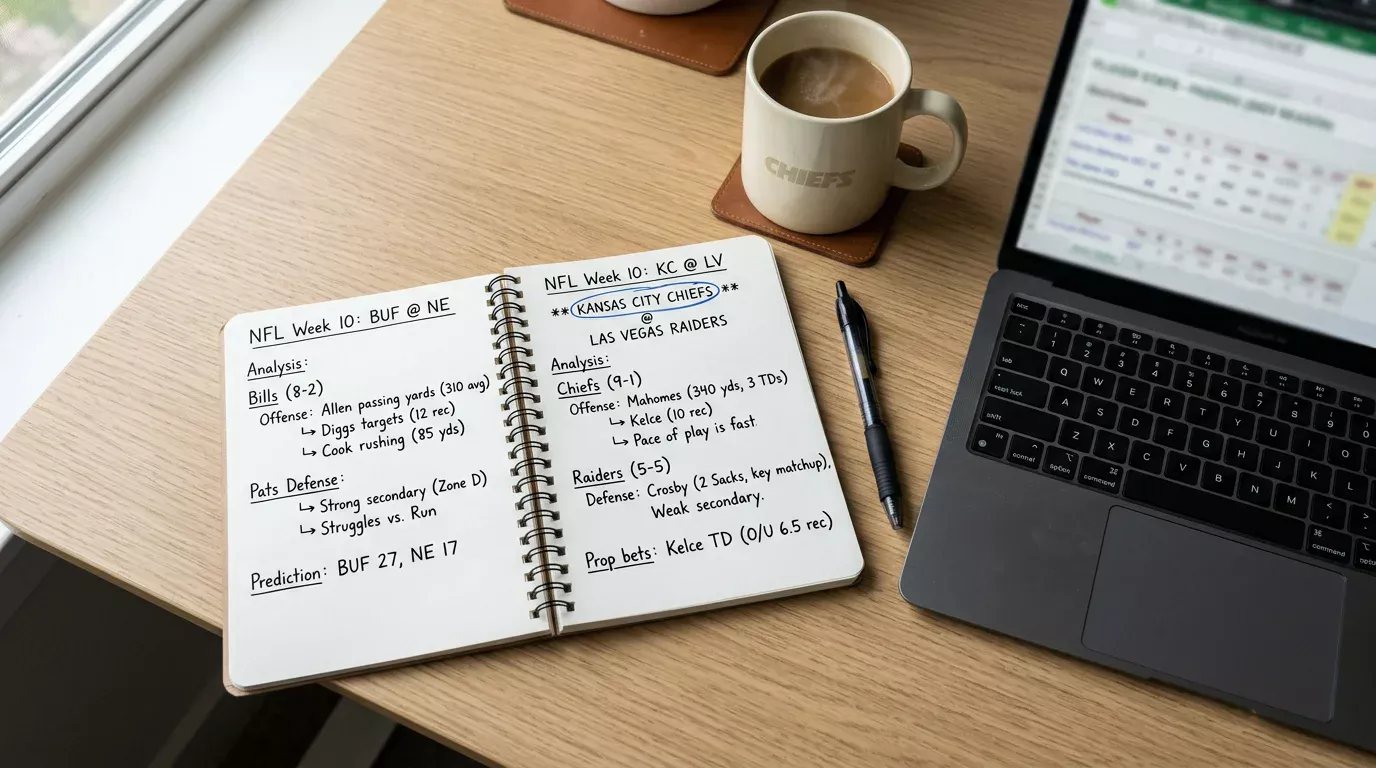
Tuesday is when my NFL week starts. The lines are released, the injury reports from the previous Sunday are beginning to filter through, and the market is at its least efficient. I spend Tuesday evening reviewing the upcoming slate and identifying three or four games where my initial read diverges from the opening line. I do not bet on Tuesday — I just flag.
Wednesday and Thursday, I track how the lines move. If a line moves toward my position, it suggests sharp money agrees with my read and the value is being eroded. If it moves away, either I am wrong or the public is pushing the number in the opposite direction, which might actually increase the value of my position. I also monitor the injury reports that teams are required to publish on Wednesday, Thursday, and Friday — the progression from “did not participate” to “limited” to “full participation” is a real-time indicator of who will actually play on Sunday.
Friday evening is when I make my final decisions. By then, the injury reports are largely settled, the lines have absorbed the midweek sharp action, and I have had several days to stress-test my initial reads against new information. I place my bets Friday night or Saturday morning, which gives me access to lines that have not yet been influenced by the late-week recreational money that floods in on Saturday and Sunday. Football accounts for approximately 34% of all US sports betting handle, and much of that volume arrives in the final 24 hours before kick-off, pushing lines in the direction the public favours.
On Sunday, I watch. I do not chase. If a game I bet on is going badly, I remind myself that the bet was placed based on analysis, not hope, and one result does not invalidate the process. After the games, I log every bet with the closing line, the result, and a one-sentence note about whether the outcome reflected the matchup factors I identified or was driven by something I did not foresee. That log — more than any tipster, model, or prediction service — is what has made me a better NFL bettor year after year. If you would like a more structured framework for building a systematic NFL betting approach, I have written extensively about the strategic foundation that supports this workflow.
Are free NFL betting tips reliable enough to stake money on?
Free tips vary wildly in quality. The problem is not that they are free — some excellent analysts share picks publicly. The problem is verification. Without a tracked, time-stamped record over at least 300 picks, you cannot distinguish a skilled analyst from a lucky one. If you follow free tips, track the results yourself over a full season before risking meaningful stakes. Treat the first season as an audition, not an income stream.
What ROI should I expect from a profitable NFL tipster?
A genuinely profitable NFL tipster operating over multiple seasons typically delivers an ROI of 3-7% on total amount wagered. That may sound modest, but compounded over hundreds of bets across a season, it represents meaningful profit. Any service claiming 15% or 20% ROI over a large sample should be treated with extreme scepticism — those numbers are not sustainable in a market where the bookmaker hold rate already exceeds 9%.
Prepared by the nfl Sports bet editorial staff.