NFL Bet Types Explained: Analyzing Spreads, Props and Accumulators
 Available in US
Table of Contents
- NFL Point Spreads: Pricing Mechanics of Handicap Wagering
- Moneyline (Match Winner): Picking the Outright Victor
- Totals (Over/Under): Betting on Combined Points
- Parlays (Accumulators): High Reward, High Margin
- Prop Bets: Player Props, Game Props and Novelty Markets
- Teasers and Pleasers: Adjusted Spreads for UK Books
- NFL Bet Types: Questions From UK Punters

If you have spent any time betting on Premier League football, you know the basics: pick a winner, pick a score, maybe throw in an accumulator on a Saturday afternoon. NFL betting starts from a completely different foundation. The dominant market is not “who wins” — it is “who wins after we give one team a head start.” That distinction trips up more UK punters than any other, and I have watched friends with decades of football betting experience misread an NFL spread because they assumed it worked like an Asian handicap. It does not. Or rather, it does, but with its own conventions, its own key numbers, and its own pricing logic.
American football generates roughly 34% of all US sports betting handle — more than basketball, baseball, or hockey. That volume is not spread evenly across market types; it clusters around spreads, totals, and increasingly around player props and parlays, each of which carries different margins, different risk profiles, and different strategic considerations. This guide breaks down every major NFL bet type, translates the American terminology into UK equivalents, and gives you enough worked examples to place any of them with confidence. I am not going to tell you which type to bet — that depends on your bankroll, your risk appetite, and where you see value. What I will do is make sure you understand exactly what you are buying before you place a penny on the line.
NFL Point Spreads: Pricing Mechanics of Handicap Wagering
Week 7 last season, I backed a three-point underdog that lost the game 24-20 but “covered the spread” — and collected my winnings. If that sentence makes sense to you, skip ahead. If it sounds like a contradiction, this section is the most important thing you will read today.
The point spread, known as the handicap in UK betting, is a margin of victory the bookmaker assigns to level the playing field between two unevenly matched teams. If the Buffalo Bills are listed at -6.5 against the New York Jets, the bookmaker is saying the Bills must win by 7 or more points for a Bills spread bet to pay out. Conversely, the Jets at +6.5 need to either win outright or lose by 6 points or fewer. The half-point eliminates the possibility of a tie on the spread — there is always a winner.
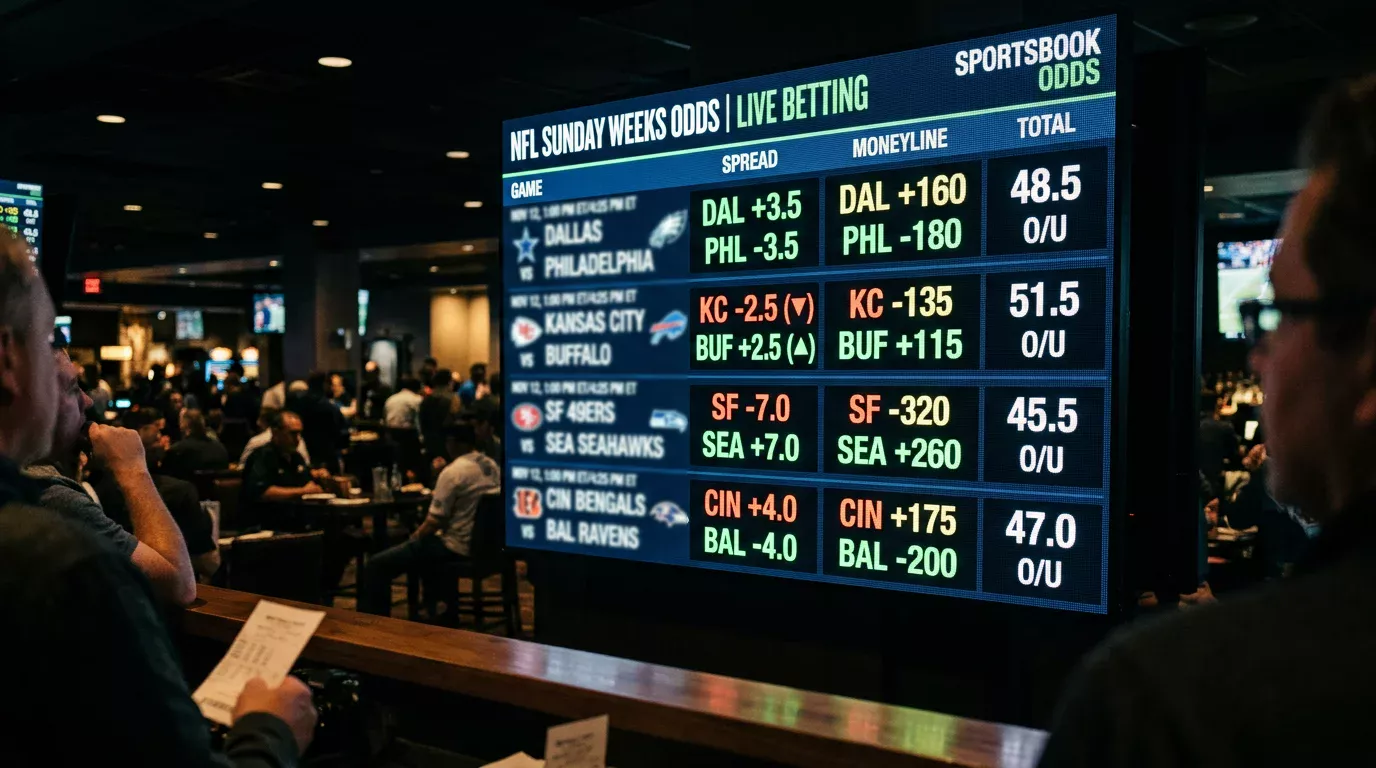
Both sides of the spread are typically priced at -110 in American odds, which translates to 10/11 fractional or 1.91 decimal. That pricing means you stake 110 to win 100, or in pound terms, 11 pounds to win 10. The bookmaker’s margin is embedded in the fact that both sides cost the same despite representing opposing outcomes — the overround sits at about 4.7%, which is the cost of playing in this market.
Why is the spread, rather than the straight-up winner, the dominant NFL market? Because NFL games are frequently lopsided. In a given week, two or three games might feature double-digit favourites. A moneyline bet on a team favoured by 14 points pays almost nothing — the risk-reward ratio is unappealing. The spread reframes the question from “who wins?” to “who wins by enough?” and that reframing produces a market where both sides attract meaningful action, which is exactly what the bookmaker needs to manage liability.
For UK punters familiar with Asian handicaps in football, the mechanics are similar but the culture around them is different. In Premier League betting, the handicap is a secondary market. In NFL betting, it is the primary one — the line that gets quoted on broadcasts, analysed in previews, and debated in every group chat. When an American says “I like the Chiefs minus three,” they are talking about the spread. When a punter at your local says “I fancy Arsenal on the handicap,” they are expressing the same idea but in a market that most UK bettors treat as an afterthought.
Two terms to know. “Covering the spread” means the team you backed met or exceeded the handicap requirement: a -6.5 favourite who wins by 10 has covered; a +3.5 underdog who loses by 2 has also covered. A “push” occurs when the result lands exactly on the spread — a -3 favourite winning by exactly 3. Pushes return your stake and are the reason key numbers (3, 7, 10) matter so much in spread betting. The number 3 is the most common margin of victory in the NFL, so the difference between backing a team at -2.5 versus -3.5 is enormous in practical terms.
Moneyline (Match Winner): Picking the Outright Victor
Sometimes you just want to pick a winner without worrying about margins of victory, and that is exactly what the moneyline — or match winner bet in UK terms — gives you. No spread, no handicap, no arithmetic about whether seven points is enough. Your team wins the game, you win the bet. Your team loses, you lose. Clean, simple, and deceptively expensive on heavy favourites.
The catch is in the pricing. A team favoured by 10 points on the spread might be priced at -450 on the moneyline, which means you stake 450 to win 100 — or in decimal terms, 1.22. That is a big outlay for a modest return, and a single upset wipes out four or five successful bets at those odds. Moneyline betting on favourites is a game of thin margins and high hit rates, where one bad week can undo a month of discipline.
Where the moneyline shines is on underdogs. A team getting +6.5 on the spread might be priced at +220 on the moneyline (3.20 decimal). If your analysis tells you the team has a genuine chance of winning outright — not just keeping it close — the moneyline offers a better payout for what is often a marginal increase in risk. I use moneyline bets selectively, almost exclusively on underdogs in games where the spread is between 1 and 4 points. In that range, the underdog wins outright often enough to make the moneyline price attractive relative to the spread.
One UK-specific note: some bookmakers label this market as “match result” or “to win” rather than “moneyline.” The mechanics are identical. NFL does not have draws in the regular season — games that are tied after regulation go to overtime, and since the 2022 rule change, regular-season overtime can end in a tie only after both teams have possessed the ball. Playoff games cannot end in a tie at all. For moneyline purposes, the result includes overtime, so a team that wins in OT pays out as a straight winner.
Totals (Over/Under): Betting on Combined Points
Do you care who wins the game, or do you care how many points are scored? Totals betting lets you ignore the result entirely and focus on the combined score of both teams. The bookmaker sets a number — say, 47.5 — and you bet whether the actual combined score will be over or under that line. If the game finishes 27-24, the combined score is 51, and the over wins. If it finishes 17-13, the combined is 30, and the under wins comfortably.
I find totals markets particularly interesting for NFL because they respond to variables that are easier to quantify than team quality: weather conditions, offensive pace, defensive rankings, and venue type. A dome game between two high-scoring offences in September will carry a total in the low 50s. An outdoor December game in Green Bay with 20 mph winds might sit at 38. Those numbers are driven by data, and the data is publicly available, which means the analytical playing field is more level than on spreads, where insider knowledge about team dynamics can create informational asymmetries.
In-play betting has transformed the totals market. Across European football, more than 60% of all online bets are placed in-play, and while NFL has not reached that proportion, live totals are growing fast. A game that starts 14-0 in the first quarter shifts the live total dramatically, and the bookmaker’s repricing creates opportunities for punters who have a view on whether the early scoring pace is sustainable or an anomaly. UK punters betting NFL totals on a Sunday evening can find live markets that are underpriced relative to how the game is actually unfolding, particularly during the early window when bookmaker attention is split across multiple simultaneous kickoffs.
Totals also serve as a useful hedge or complement to spread bets. If you like a team on the spread but think the game will be lower-scoring than the market expects, pairing a spread bet with an under can create a position where both legs win in your preferred scenario (a tight, defensive game where your team covers a small spread). That is not a parlay — it is two independent bets with a correlated thesis, and the risk management is entirely different.
Parlays (Accumulators): High Reward, High Margin
Parlays are the siren song of sports betting. Combine three, four, five selections into a single bet, watch the potential payout multiply into something genuinely exciting, and then — almost always — watch one leg fail and take the entire ticket down with it. I have placed my share of parlays over the years, and I have hit some beautiful ones. But the maths is ruthless, and the more honestly you look at it, the harder it is to justify making parlays a regular part of your strategy.
In UK terms, a parlay is an accumulator — an acca. You combine multiple independent selections into a single bet, and all legs must win for the bet to pay out. The appeal is obvious: a four-leg parlay at 1.91 decimal per leg pays roughly 13.3 to 1 instead of the 0.91 profit you would earn on each leg individually. The problem is equally obvious: your win probability drops from roughly 52% on a single well-chosen spread bet to about 7.4% on a four-leg parlay, and the bookmaker’s margin compounds with every leg you add.
The numbers from the US market tell the story. Parlay bets accounted for 22% of all sports betting handle in 2024, but the hold rate on parlays exceeded 15% — roughly double the hold on straight spread bets. That gap is the margin multiplier in action. Each leg carries its own overround, and when you chain four overrounds together, the effective margin is not 4.7% times four; it compounds, because you are paying the bookmaker’s edge on the outcome of the first leg, then on the conditional outcome of the second given the first, and so on. Jim Strode of Ohio University captured the dynamic neatly when he described the NFL as fundamentally a revenue-seeking business — and the parlay product is where that revenue extraction is most aggressive. The league, the broadcasters, and the bookmakers all benefit from the excitement parlays generate. The punter, structurally, does not.
Does that mean you should never place a parlay? Not necessarily. I use small-stake parlays in two specific scenarios: when I want to combine two positions that are positively correlated (a strong defensive team to cover a small spread and the game to go under) and when I am allocating a fraction of my recreational budget to a high-upside bet with money I have already mentally written off. The key word is “recreational.” A parlay is entertainment, not strategy. If parlays are the backbone of your NFL betting approach, you are funding the bookmaker’s quarterly bonus, not building your own bankroll.
For a deeper look at how to structure accumulators more intelligently — optimal leg counts, correlation analysis, and whether acca insurance promotions offer genuine value — there is a dedicated guide on building smarter NFL accas.
Prop Bets: Player Props, Game Props and Novelty Markets
Last February, I bet on a quarterback to throw for over 275.5 yards in the Super Bowl. I did not have a strong view on who would win the game or by how much, but I had spent two weeks studying the matchup and concluded that the defensive scheme the underdog planned to deploy would force the opposing quarterback into a high-volume passing game. He threw for 312 yards. The bet paid at 1.87 decimal. That is the beauty of prop bets — they let you express a specific analytical opinion without needing to predict the overall outcome.
Prop bets — short for “proposition” — fall into two broad categories. Player props are tied to individual statistical performances: passing yards, rushing yards, receptions, touchdowns scored. Game props are tied to events within the game: first scoring method, total touchdowns, which team scores first, winning margin. Beyond those, particularly around the Super Bowl, novelty props emerge for everything from the coin toss result to the length of the national anthem. The expected handle for Super Bowl LX was projected at $1.76 billion, and a significant portion of that money flows into prop markets that do not exist for any regular-season game.
For UK punters, player props are the most strategically interesting category. Bookmakers price these markets using statistical projections — often derived from the official NFL data feeds distributed by Genius Sports — but the projections are less refined than spread or total pricing because the variables are more granular. A quarterback’s passing yards depend not just on his ability but on the opposing secondary, the game script (teams trailing throw more), weather conditions, and even the pace at which his offence operates. If you are willing to do the work of modelling those interactions, you can find lines that are consistently softer than the primary markets.
Game props carry wider margins because they attract recreational money — bettors who want a stake in “who scores first” without doing any research. The bookmaker knows this and prices accordingly. I use game props sparingly, and only when I have a game-script thesis: if I believe a game will be low-scoring and defensive, for example, a bet on the first score being a field goal rather than a touchdown can offer value at prices the market underestimates.
A word of caution on novelty props: the coin toss, the Gatorade colour, the anthem length — these are pure entertainment bets with zero analytical edge. The bookmaker’s margin on them is typically higher than on any other market, and they exist solely because the Super Bowl attracts millions of casual bettors who want to participate without caring about expected value. Enjoy them for what they are, stake accordingly (which means minimally), and do not let them bleed into your serious bankroll.
Teasers and Pleasers: Adjusted Spreads for UK Books
Imagine you could buy extra points on a spread — shift a -7.5 line down to -1.5, turning a risky position into something far more comfortable. That is a teaser. The trade-off is that you must combine two or more selections, and the payout is reduced to account for the additional points you have received. It is a structured compromise between a straight bet and a parlay, and when used correctly, it is one of the few multi-leg bet types that can offer genuine mathematical value.
The standard NFL teaser gives you six additional points on each leg. A two-team, six-point teaser moves both spreads in your favour: a -8 favourite becomes -2, and a +1 underdog becomes +7. The payout on a two-leg teaser at -110 juice is typically around -120 (1.83 decimal), which means you are accepting a significantly lower return than a parlay for significantly higher win probability. The strategic logic is built on key numbers: if you can tease through 3 and 7 — the two most common NFL margins of victory — you are converting the highest-frequency losing outcomes into wins or pushes. A -7.5 teased to -1.5 crosses both 7 and 3. A +1.5 teased to +7.5 crosses 3 and 7 from the other direction.
Pleasers are the inverse: you give up points in exchange for a higher payout. A six-point pleaser on a -3 favourite moves the line to -9, making it much harder to cover, but the price reflects the increased difficulty. Pleasers are rarely offered at UK bookmakers and even more rarely represent good value. The bookmaker’s margin on pleasers tends to be wide enough to make them a poor long-term proposition. I have experimented with them in small stakes and found the win rate too low to justify the theoretical payout advantage.
Not all UK bookmakers offer NFL teasers. Availability has improved in recent years as American football has grown in popularity, but you may need to check multiple platforms to find them. When you do find them, pay attention to the juice — some operators charge -120 on two-team teasers, others -130, and that difference in price matters just as much as on straight bets. A well-constructed teaser through the right key numbers at fair juice is a genuinely useful tool. A teaser at inflated juice on numbers that do not cross key thresholds is just a parlay with a nicer name.
NFL Bet Types: Questions From UK Punters
What does ‘covering the spread’ mean in NFL betting?
Covering the spread means the team you backed met the handicap requirement set by the bookmaker. If you bet on a team at -6.5 and they win by 7 or more, they covered. If you bet on the opponent at +6.5 and they lose by 6 or fewer (or win outright), they covered. The spread reframes the bet from ‘who wins’ to ‘who wins by enough’ — and covering is the threshold that determines your payout.
Are NFL accumulators worth it given the bookmaker’s overround?
From a pure expected-value perspective, accumulators are the worst bet type available because the bookmaker’s margin compounds with each additional leg. A four-leg acca at standard NFL spread prices carries an effective overround roughly four times higher than a single straight bet. They can be enjoyable as small-stake recreational bets, but if you are building a serious NFL betting strategy, straight bets on spreads and totals offer a structurally better return over time.
Which NFL bet type has the lowest bookmaker margin on average?
Standard spread bets at -110 on each side carry the lowest typical overround — around 4.5% to 5%. Totals are priced similarly. Moneyline margins vary with the size of the favourite: close games have tight moneyline margins, while heavy favourites carry wider margins because the underdog side attracts less volume. Prop bets and parlays carry the widest margins, often exceeding 8% and 15% respectively.
Can I combine player props in a bet builder at UK bookmakers?
Yes, most major UK bookmakers now offer NFL bet builders (also called same-game multis) that let you combine player props with game outcomes within a single match. Be aware that the pricing on these combinations includes a correlation adjustment and an additional margin layer, so the odds you receive will typically be lower than if you multiplied the individual prop odds together. The bookmaker’s hold on bet builders is significantly higher than on straight bets.
Prepared by the nfl Sports bet editorial staff.