NFL Betting Strategy: Bankroll Systems and Finding Price Value
 Available in US
Table of Contents
- NFL Bankroll Systems: Implementing Strict 1-3% Staking Rules
- Line Shopping and Closing Line Value Across UK Books
- Key Numbers in NFL Spreads: Why 3 and 7 Decide Bets
- Rest Days, Short Weeks and Schedule-Based Edges
- Fading Public Money: When Contrarian Betting Pays
- Adapting Strategy Across the NFL Season: Preseason to Playoffs
- NFL Betting Strategy: Common Questions

I lost my first full NFL season bankroll in eleven weeks. Not because I picked badly — my win rate hovered around 53% — but because I had no system. I staked too much on Thursday night games I barely researched, doubled down after losses, and treated every parlay like a lottery ticket. That was nine years ago, and the single lesson it taught me still underpins every wager I place: without a repeatable process, even good picks bleed money.
The bookmaker’s edge has only grown since then. The average hold rate across regulated US sportsbooks climbed from 6.7% in 2018 to above 9% by 2025, and UK operators are no different — they have sharpened their pricing models, tightened their margins on marquee markets, and built products like bet builders specifically designed to widen the gap between what punters pay and what they should pay. The $30 billion wagered on the 2025 NFL season through legal channels tells you the appetite is enormous, but the rising hold rate tells you the house is taking a bigger slice of every pound and dollar that flows through the window.
This guide is not a collection of tips. It is a system — the same system I use week in, week out, refined across nine seasons of NFL betting from the UK. Every section addresses a specific edge: bankroll discipline, line shopping, key number exploitation, schedule analysis, contrarian positioning, and seasonal adaptation. I have stripped out the theory that sounds clever in a textbook but falls apart on a Sunday afternoon, keeping only the methods that survive contact with real markets and real variance. If you already know what a spread is and why a parlay usually costs more than it should, you are in the right place. If not, start with the full breakdown of NFL bet types and come back here with a working vocabulary.
NFL Bankroll Systems: Implementing Strict 1-3% Staking Rules
A mate of mine — sharp analyst, genuinely talented at reading matchups — went bust twice in three years. Both times, the problem was the same: he sized his bets by gut feeling. A game he “loved” got five units. A Thursday night divisional tilt he fancied got three. By Week 8, half his bankroll was riding on five or six positions, and a single bad Sunday wiped him out. The numbers were never going to save him because the structure was rotten.
Bankroll management is the least exciting part of NFL betting and the only part that determines whether you survive long enough for your edge to compound. The rule I follow is simple: never risk more than 1-3% of your total bankroll on a single selection. If your bankroll is 1,000 pounds, that means 10 to 30 pounds per bet — no exceptions, no “special plays,” no unit inflation because you feel strongly about a line. The moment you start adjusting stake size based on conviction, you have introduced a variable that is driven by emotion rather than process, and emotion is the fastest way to turn a profitable record into a losing one.
Why 1-3% and not a flat percentage? Because confidence levels are real — they just need to be constrained. I use a three-tier system: 1% for standard plays where I see slight value, 2% for plays where I believe the line is materially mispriced, and 3% for rare situations where multiple indicators converge — strong closing line value in early markets, an injury report the line has not yet absorbed, schedule advantage, and a key number alignment. In nine years, I have placed a 3% bet perhaps twice a month during the regular season. It should feel uncommon. If you are hitting your top tier every week, your tiers are too loose.
The data behind this discipline is bleak enough to keep you honest. Research from 2023 found that 45% of NFL bettors admitted staking more than they could afford to lose. That is not a fringe problem — it is nearly half the market. And the ones who go broke fastest are not the ones with bad picks; they are the ones who overexpose their bankroll to a single outcome. A 53% win rate on spreads at standard -110 juice produces a modest long-term profit. But that profit only materialises across hundreds of bets, and you need your bankroll intact to get there.
Track everything. I use a spreadsheet — nothing fancy, just date, game, market, odds, stake, and result. At the end of each month, I calculate return on investment and compare it to my closing line value. If the ROI is negative but my CLV is positive, I know I am making good bets that variance has punished. If the CLV is negative, I know my process is off. Without that data, you are flying blind, and no staking plan in the world can fix decisions you cannot measure.
One more point worth stressing: your bankroll is not your bank balance. It is a ring-fenced sum allocated exclusively to NFL wagering. If you cannot lose the entire amount without it affecting your rent, your groceries, or your peace of mind, the bankroll is too large. Set it, fund it, and treat every pound inside it as a tool for generating returns — not money you need back by February.
If these advanced bankroll systems seem overwhelming, we recommend starting with our NFL betting guide for beginners to build a solid foundation.
Line Shopping and Closing Line Value Across UK Books
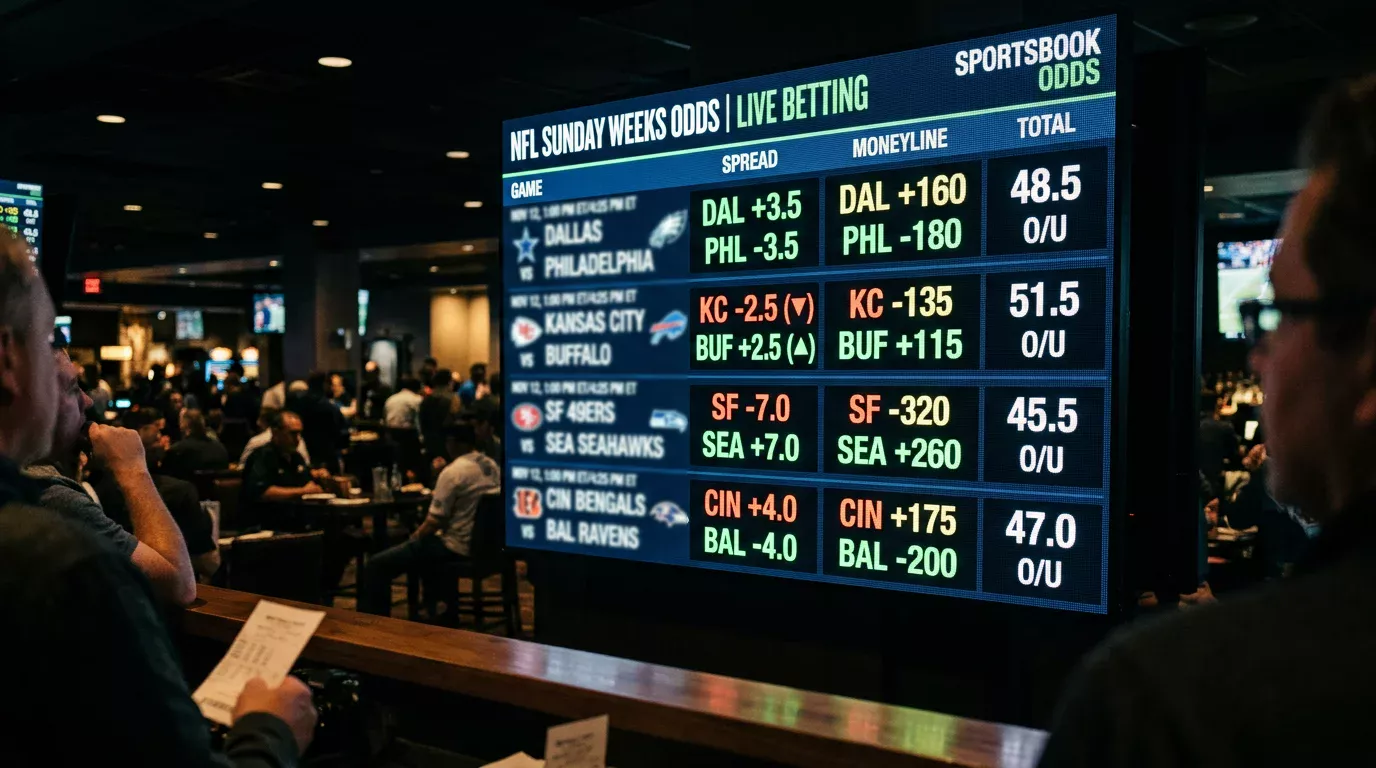
In the 2024 season, I tracked a single Week 12 spread across six UK bookmakers at the moment the line opened on Sunday evening. The favourite was listed at -3 with three operators, -3.5 with two, and -2.5 with one. That half-point gap between -2.5 and -3.5 on an NFL spread is not a rounding error — it is the difference between a push and a loss on one of the most common margins in the sport. If you are not checking multiple books before placing every bet, you are volunteering to take worse prices than the market offers.
Line shopping is the single easiest edge available to any punter with more than one bookmaker account. It requires no analytical skill, no model, no insider knowledge — just the discipline to compare prices before committing. The US legal market processed $165.58 billion in total handle in 2025, and that volume creates a liquid, efficient market where prices converge quickly. But “quickly” is not “instantly.” Lines open at different times across operators, injury news filters through at different speeds, and each bookmaker’s risk management team reacts to sharp money on its own schedule. Those gaps are real money.
The metric that tells you whether your line shopping is working is closing line value, or CLV. The closing line is the final price offered just before kick-off, after all available information has been absorbed and the sharpest money has moved the number. If you consistently beat the closing line — that is, you take prices that are better than where the line finishes — you are, by definition, capturing value the market later removes. Over a large sample, positive CLV correlates strongly with long-term profit regardless of short-term results.
Here is how I use CLV in practice. Every Monday morning, I compare the odds I took on each bet against the closing line. If I backed a team at -2.5 and the line closed at -3, I captured half a point of CLV. If I backed at -3.5 and it closed at -3, I gave up half a point. I record this for every bet and calculate the average across the season. A consistent average CLV of +0.5 to +1 point on spreads tells me my timing and book selection are sound, even during weeks when results go against me. If the average turns negative for three or four consecutive weeks, I review my process — am I betting too late, missing line moves, or relying on a single operator too heavily?
For UK punters specifically, the timing challenge is real. NFL lines often open on Sunday night UK time and move sharply on Monday morning when US-based sharps get active. If you wait until Thursday or Friday to place your bets, you are almost certainly taking a line that has already been picked clean. My routine: check openers on Sunday evening, compare across books on Monday morning, and place the bet if the line is where I want it. If it has already moved past my number, I let it go. There will always be another game next week.
A practical note on accounts: you need a minimum of four UK bookmaker accounts to line shop effectively on NFL. Fewer than that, and you are simply not seeing enough of the market. More than six becomes diminishing returns unless you are betting at volume that justifies the admin. Open the accounts, verify them, fund them with a portion of your bankroll allocated proportionally, and treat the few minutes of comparison as the cheapest edge in the sport.
Key Numbers in NFL Spreads: Why 3 and 7 Decide Bets
Why does the number 3 appear on NFL spreads more than any other figure? Because a field goal is worth three points, and NFL games are decided by exactly three points roughly 15% of the time. That single statistic reshapes every spread bet you will ever place.
Key numbers in NFL betting are the margins of victory that occur with disproportionate frequency. The two most important are 3 and 7 — field goal and touchdown. After those, 6 (touchdown without the extra point conversion), 10 (touchdown plus field goal), and 14 (two touchdowns) show up more often than surrounding numbers. The practical consequence for punters is straightforward: the difference between getting a team at -2.5 versus -3, or -6.5 versus -7, is not a trivial half-point — it is a boundary that determines outcomes in a meaningful percentage of games.
I think of key numbers as toll gates. Every time a spread crosses one of these thresholds, the bet’s expected value shifts noticeably. Paying -110 to take a team at -3 is a fundamentally different proposition from paying -110 to take them at -3.5, because the 3.5 line loses on every game decided by exactly a field goal, while the 3 line pushes. Over a full season of 272 regular-season games, that distinction affects dozens of outcomes.
The strategic application is twofold. First, when you are line shopping, prioritise the books that have the spread on the favourable side of a key number. Getting -2.5 instead of -3 at the same juice is a material improvement. Getting +3.5 instead of +3 on the other side of the same game is equally significant. Second, when considering teasers — a bet type where you buy additional points on a spread — the optimal approach is to tease through key numbers. A six-point teaser that moves a -7.5 favourite to -1.5 crosses both 7 and 3 on the way down, converting two of the most common losing margins into wins or pushes. That is the mathematical basis of the Wong teaser, a strategy built entirely around key number exploitation.
One mistake I see constantly: punters treating all half-point differences equally. Moving from -5.5 to -5 is useful but modest, because games rarely land on exactly 5 points. Moving from -3.5 to -3, by contrast, is one of the highest-value half-point shifts in all of NFL betting. Know which numbers matter, and spend your energy — and your line shopping time — on the spreads that sit near those boundaries. Everything else is noise.
Rest Days, Short Weeks and Schedule-Based Edges
September 2024, Week 4: a team coming off a Monday night game travelled cross-country to play an early Sunday kickoff six days later. Short rest, long flight, early start. They lost outright as a three-point favourite. I had the other side, not because I predicted the upset, but because the schedule told me the favourite was walking into a structural disadvantage that the line had not fully priced.
The NFL schedule is not random. It is a 272-game puzzle built around television contracts, stadium availability, and competitive balance mandates. Within that puzzle, certain configurations create measurable edges. The most consistent: teams on short rest — typically those playing Thursday Night Football after a Sunday game — perform worse against the spread than teams on standard rest. The effect is not enormous, but across a full season, it is reliable enough to factor into your process.
Short weeks compress preparation time. Coaches have fewer days to install a game plan tailored to the opponent. Players recovering from the physical toll of a Sunday game have less time to heal. Travel compounds the problem — a West Coast team flying east for a Thursday game is operating on a compressed timeline with disrupted body clocks. The bookmakers know this, of course, and they adjust the line accordingly. But they do not always adjust it enough, particularly early in the season when public money tends to back the more recognisable name regardless of schedule context.
The flip side is the rest advantage. Teams coming off a bye week — a scheduled week of no play — historically perform well against the spread in their first game back. They have had two weeks to prepare for a single opponent, their injured players have had extra recovery time, and coaches have been able to address weaknesses exposed in recent games. The market accounts for this partially, but the bye-week edge has persisted across multiple seasons, suggesting it is underpriced more often than not.
How I apply this: before the season starts, I mark every short-week game and every post-bye game on the calendar. These are not automatic bets — schedule context is one input among several — but they are situations where I look harder for value. If a post-bye team is playing a short-week opponent and the spread is near a key number, that is a convergence of factors worth serious attention. If the schedule edge is the only thing going for a play, I pass. Edges compound; they rarely work in isolation.
One caveat for UK punters: the three London games each season create a unique schedule wrinkle. Both teams travel, both lose their home-field advantage, and both face disrupted preparation. The schedule dynamics around those games — which teams play the week before, which have a bye after — often produce pricing anomalies that domestic bettors overlook. Keep an eye on them.
Fading Public Money: When Contrarian Betting Pays
The public loves a favourite, and the public loves a parlay. Those two tendencies, taken together, explain a meaningful chunk of the bookmaker’s profit margin. Parlay bets — accumulators in UK terms — accounted for 22% of all US sports betting handle in 2024 but generated a hold rate above 15%, roughly double the hold on straight bets. The reason is mechanical: each leg of a parlay multiplies the bookmaker’s built-in edge, so a four-leg acca does not just combine four bets, it compounds four margins. The public appetite for these high-payout, low-probability wagers is the single largest subsidy recreational bettors provide to the sportsbook industry.
Fading public money means betting against the side that attracts the heaviest casual action. The logic is not that the public is always wrong — they are right more often than not on big favourites — but that their enthusiasm distorts prices. When 80% of tickets land on one side of a spread, the bookmaker has two choices: accept the lopsided liability or move the line to attract action on the other side. If the line moves toward the popular side despite lopsided ticket counts, that is a strong signal that sharp money is on the opposite side, and the book is willing to take the public’s action at a price it considers favourable to the house.
Bill Miller, CEO of the American Gaming Association, framed the broader picture when he noted that legal betting enhances the fan experience. He is right about engagement — more people than ever are watching games with a stake in the outcome. But enhanced engagement does not mean enhanced decision-making. Casual bettors bet with their eyes on the narrative: the team on a winning streak, the quarterback with the highlight reel, the primetime showdown everyone is talking about. Narrative-driven money is predictable money, and predictable money creates opportunities for those willing to go against the grain.
I do not fade the public blindly. The strategy has conditions. First, the game needs to be a high-profile matchup that attracts disproportionate casual attention — Sunday Night Football, Monday Night Football, playoff games, or any game featuring a nationally prominent team. Second, the ticket split needs to be heavily one-sided, typically 70% or more on one team. Third, the line movement needs to diverge from the ticket count — if 75% of bets are on the favourite but the line moves from -6 to -5.5, that reverse movement suggests professional money is on the underdog. When all three conditions align, I have a contrarian play worth evaluating against my other criteria.
The risk of contrarian betting is obvious: sometimes the public is right, and the favourite wins by three touchdowns. The protection against this is not conviction but position sizing. Contrarian plays get my standard 1% stake, occasionally 2% if the line shopping and key number factors also converge. I never overweight a fade just because the crowd is loud. The edge is statistical, not prophetic, and it only pays across a large sample of disciplined, well-sized bets.
Implement these proven systems using the data provided by our trusted NFL sports betting portal.
Adapting Strategy Across the NFL Season: Preseason to Playoffs
The NFL season is not one market — it is four distinct markets stitched together, and the strategy that works in September can cost you money in January. I learned this the hard way during my third year of serious betting, when I carried a profitable regular-season approach straight into the playoffs without adjusting anything and promptly gave back three weeks of gains in a single weekend.
The preseason, running through August, is the loosest and least efficient market in NFL betting. Starters play limited snaps, depth charts are in flux, and coaching strategies are deliberately obscured. Lines are softer because the bookmakers have less data to price them accurately, and the betting public is sparse enough that sharp action can move numbers quickly. I treat preseason as a research phase rather than a betting phase — I watch for coaching tendencies, note which teams are integrating new personnel, and build my early-season models. If I spot a genuinely mispriced total or spread, I will take it, but the volume is low and the conviction threshold is high. Most of my preseason “bets” are on futures: division winners, conference winners, and season win totals, where the market is pricing outcomes months in advance and small informational edges can compound into significant value.
The early regular season — Weeks 1 through 6 — is where the market is most uncertain and, paradoxically, where the most value exists. Bookmakers are pricing based on preseason expectations, power ratings from the previous year, and limited current-season data. Overreaction is rampant: a team that wins its opener by 20 points sees its line inflate the following week, often beyond what the performance actually warrants. I lean heavily on schedule edges and preseason research during this stretch, and I am at my most aggressive with line shopping because early-season lines diverge more across operators than at any other point in the year.
The mid-season grind, roughly Weeks 7 through 14, is the most efficient phase. By now, the market has absorbed enough data to price teams accurately, casual bettors have settled into patterns, and the lines tighten. This is where discipline matters most. I reduce my volume — fewer bets, higher selectivity — and focus on situations where specific structural advantages (rest edges, key number positioning, late-breaking injury news) create windows that the market cannot close instantly. The mid-season is not where you build your bankroll; it is where you protect it.
Then come the playoffs. Single-elimination football changes everything. The sample sizes for any given matchup drop to one, variance spikes, and the market is flooded with casual money chasing narratives. Totals tend to be mispriced because playoff games historically skew lower-scoring than the regular season — defences tighten, game plans become more conservative, and the intensity level makes turnovers more frequent. I focus on totals and underdogs during the postseason. The public hammers favourites in primetime playoff spots, and the contrarian edge that operates modestly during the regular season becomes more pronounced when the entire nation is watching and betting on the same team.
The Super Bowl is a category unto itself. The expected handle for Super Bowl LX was projected at $1.76 billion, a number that dwarfs any regular-season week. That volume includes an extraordinary amount of recreational money flowing into prop markets, novelty bets, and straight-up match winners with no analytical basis. The sheer weight of uninformed action creates pricing distortions, particularly in the prop markets where the bookmaker’s hold is already wider. I allocate a specific, small portion of my bankroll to Super Bowl props each year, targeting markets where I believe the line reflects public enthusiasm rather than statistical probability. The rest of my Super Bowl betting is the same process as any other week: spread, total, line shopping, key numbers, stake discipline.
Adapting across these phases is not optional — it is the difference between a system that produces returns over a full season and one that collapses when the market environment shifts. Build your calendar, mark the transitions, and adjust your volume, aggression, and focus accordingly. The punters who treat September and January as the same market are the ones whose money ends up in someone else’s bankroll by February.
NFL Betting Strategy: Common Questions
What bankroll percentage should a beginner stake per NFL bet?
Start at 1% of your total bankroll per bet. This means if you have set aside 500 pounds for NFL wagering, each bet should be 5 pounds. Once you have tracked at least 100 bets and can demonstrate positive closing line value over that sample, you can introduce a tiered system with a maximum of 3% on your strongest plays. The priority for beginners is survival — keeping the bankroll intact long enough to learn.
How early should I place NFL bets to capture the best value?
For most regular-season games, the optimal window is Sunday evening through Monday morning UK time, when lines first open and before US-based sharp bettors have moved the numbers significantly. By Thursday, the majority of value has been extracted. There are exceptions — late injury news can reopen value on game day — but as a default, earlier is better, provided you have done your research.
Do rest-day advantages still hold in the current NFL scheduling format?
Yes. Teams on short rest, particularly those playing Thursday Night Football after a Sunday game, continue to underperform against the spread at a rate that creates exploitable value. The effect is modest — typically one to two percentage points of ATS underperformance — but it compounds over a full season. Bye-week advantages remain similarly persistent, though the market prices them more accurately than it did five years ago.
Is it profitable to fade public money on NFL spreads long-term?
Fading the public is not profitable as a standalone strategy applied to every game. It becomes profitable when filtered for high-profile matchups with heavily lopsided ticket splits and reverse line movement. Under those conditions, contrarian positions on underdogs have historically produced a positive return on investment across multi-season samples. The key is selectivity — blind contrarianism is just another way to lose money with extra steps.
Created by the ”nfl Sports bet” editorial team.